Timestamps follow the original livestream. Select a time to watch that moment. Transcripts are machine-generated with reviewed name and terminology corrections; occasional recognition errors may remain.
31:48I'm Belinda and this is Keon and we're from Anthropic.
31:51We work with financial services firms.
31:55As Keon gets set up here, we'll start with a little bit of background.
31:58My name is Belinda Neal, and I'm the Managing Director of Financial Services at Anthropic.
32:03Previously to joining Anthropic this year, I worked at Goldman Sachs for 19 years across engineering, global markets, and equity research.
32:09My role at Anthropic sits at the confluence of our industry, our product, our research, and our go-to-market teams,
32:16really in accelerating the adoption of AI within financial services.
32:21Good morning, everyone. Thanks for being here.
32:23My name is Keon Shahab. I'm an Applied AI Architect at Anthropic.
32:26Prior to Anthropic, I spent five years at Databricks
32:29helping financial services companies
32:30modernize their data and AI architecture.
32:34So we're excited to speak to you this morning,
32:36and our talk is going to cover three ideas.
32:39Firstly, the frontier of intelligence.
32:42How is this room taking the frontier models
32:44and applying it in ways that create alpha or edge
32:48The second is the frontier of adoption.
32:50How are you scaling what you've built
32:52based on the foundation of a few to many?
32:54And then last, how are we applying it to financial services?
32:58We're going to bring an example in here about how we've been innovating in the wealth industry
33:02in Claude for financial advisors.
33:03And that paradigm compounds potentially to other areas of financial services as well.
33:09So let's get started and talk about the frontier of intelligence.
33:13So every so often, a model crosses a threshold.
33:16And when it does, a way of working changes.
33:18We first saw this encoding last year with Opus 4.5 and Claude code.
33:24Many of you in the room are using these tools,
33:26and you've gone from autocomplete encoding
33:28to managing fleets of agents
33:30where you're really driving and accelerating
33:32a multiple effect of how you're doing coding.
33:35We also saw this threshold cross this year
33:37in cyber with Claude Mythos Preview,
33:39and many of you are also spending time
33:41on the cyber programs in your firms.
33:47We've started now in finance with early agents
33:49and bringing Claude into the products and services
33:51that you use day to day.
33:53One example here is Citadel told us at our briefing event in May that their investment professionals started to use Claude for Excel, and it gives them a step change function in how they can test, build, and trust their work.
34:06We're really excited for the potential of Claude within the tools and the use cases that this room is building.
34:13But here's the challenge.
34:16Intelligence is ahead of adoption.
34:17What a model can do on its own is doubling every four months.
34:22PwC published early this year
34:24that the capabilities of AI
34:26are going to three quarters of companies.
34:30Sorry, three quarters of the economic gains of AI
34:32are going to a fifth of companies.
34:33This is what we call the diffusion gap.
34:35If you're not building close enough to the curve,
34:38there's opportunity for you to take the frontier
34:40and be able to apply it in your workflows.
34:43We work with firms across financial services,
34:46across our model family,
34:47most of which hopefully this room is familiar with.
34:51for speed and volume.
34:53Sonnet for everyday work.
34:55Opus as the daily driver for financial services,
34:58complex tasks, and agentic coding.
35:00And Fable, our frontier model
35:02that can effectively be used
35:04for the hardest work in your firms.
35:06One example here from Millennium
35:07on our most recent model blog
35:12to find a piece of code
35:15and it was unexplained in five years.
35:17Fable was able to find it.
35:18We're starting to see our models get used in this industry in new and creative ways,
35:23and we believe the frontier of intelligence is just getting started.
35:27Every model release gets smarter, cheaper and safer, so it's really important to take
35:31a minute to call out how the model frontier is continuing to develop here.
35:35Firstly, the intelligence is going up.
35:37Now a model can work for 16 plus hours on its own.
35:41This is up from just minutes in 2023.
35:45In terms of cost per task, it's going down.
35:47The most recent Opus 5.5 model was 40% more cost-efficient than Opus 5.
35:53You can also see those impact metrics for Haiku, Sonnet, and Fable.
35:59This is something we care a lot about at Anthropic.
36:01In the most recent model of Fable 5.1, only 1% of propped injection attacks were successful.
36:08This is relative to other frontier models in the region of 9% to 53%.
36:11So we're really investing in safety alongside capability at Anthropic.
36:16And the banks know this.
36:17The last most recent Evident AI 2026 report that came out last week showed us that banks are 26% ahead of their AI maturity scores.
36:26We're really investing in scaling in applying this technology to our industry.
36:30A few use cases to call out from this report, which are publicly citable use cases that have been reported, is firstly on areas like fraud.
36:38One bank found that with auto loans, they were able to reduce $120 million of potential fraud in 12 months.
36:45In another area, in post-earnings research,
36:48a draft of a report was able to be generated in 15 minutes relative to 45 minutes.
36:53And you can see other use cases here and more broadly across the industry
36:56as we start to talk about the value of AI and the impact we're generating on our business.
37:03In 2023, we built chatbots.
37:06Everyone was asking a question and going backwards and forwards with the model.
37:09In 2024, we brought pilots to firms
37:12and we started to get more knowledge bases and data into these AI systems.
37:17From 2025 to now, we're now building agents.
37:20And in the most case in this room, we're building them hand by hand, one by one.
37:24And our opportunity here to scale is not the model.
37:27Our opportunity here to scale is building the foundation for agents that can go from one to many.
37:32So the next part of the talk, we wanted to spend time focusing on how you can build the agent foundation
37:37that will allow you to scale the frontier of adoption.
37:40So over to you, Keon.
37:42Thank you, Belinda. So, Belinda, as you've just said, there's no better time than now to start
37:47experimenting and building with agents. For this portion of the talk, we want to talk a little bit
37:51about how you can go from that experimentation phase towards productionizing and scaling agents.
37:58But first, some observations that we've seen across the industry. A year ago, we could think
38:03about this as the year of exploration, where engineers were working on a handful of use cases.
38:09They were in POC and pilot mode.
38:11And they took their learnings and transitioned that into this year,
38:14where we've seen this be the age of production.
38:18So we've seen these handful of agents go to production.
38:21A lot of them have been built by hand.
38:23What I think will happen next year is we'll go into the age of scale.
38:26We'll have many agents built on one solidified foundation.
38:34And as Belinda just mentioned,
38:36the models are now the easiest part of the equation here.
38:39We know that the models can handle high-quality tasks,
38:42and we're confident about that.
38:43But what we want to talk about here
38:45is building this five-layer framework
38:47for scaling and productionizing your agents.
38:50Starting from the bottom,
38:51we first want to look at what the agent can do.
38:54So we can give it context for our business use cases
38:58via connectors so that it can reach our systems and data.
39:01Then we want to give it context
39:02for our actual business rules and processes via skills.
39:06Once that's done, we want to think about building the trust layer for the agents.
39:10We can think about that in three general steps.
39:13Who the agent is acting as with an identity and permissions layer, how we can sandbox and
39:19determine the approval layer of the agent so that someone is signing off before it acts,
39:24and lastly, how we know the agent will still work once we adjust any variables over time.
39:30So let's look at each of these five.
39:34So if you've started building agents already, you may think of giving those agents access to your underlying systems and data, manually wiring them by hand to a handful of different source systems.
39:46And that could work for maybe five agents and five systems.
39:49Then you'll have 25 systems to maintain and manage.
39:53But as you think about scaling up your agents into new specialized various tasks,
40:00want to have those agents work off of one secure connectivity layer, which is MCP. That'll make it a lot easier for you to build at scale with one repeatable framework. Next, let's say now we have the agent have context to our underlying business data and systems. Now we want to give it more context to
40:25into our actual business rules and processes.
40:27And that's done through skills.
40:29And this is where the SMEs that really do the work
40:31and understand the process and the work come into the picture.
40:35And from here on, we're going to look at an agent use case
40:39for a trade break investigation agent.
40:42And we're going to follow this across for the next steps.
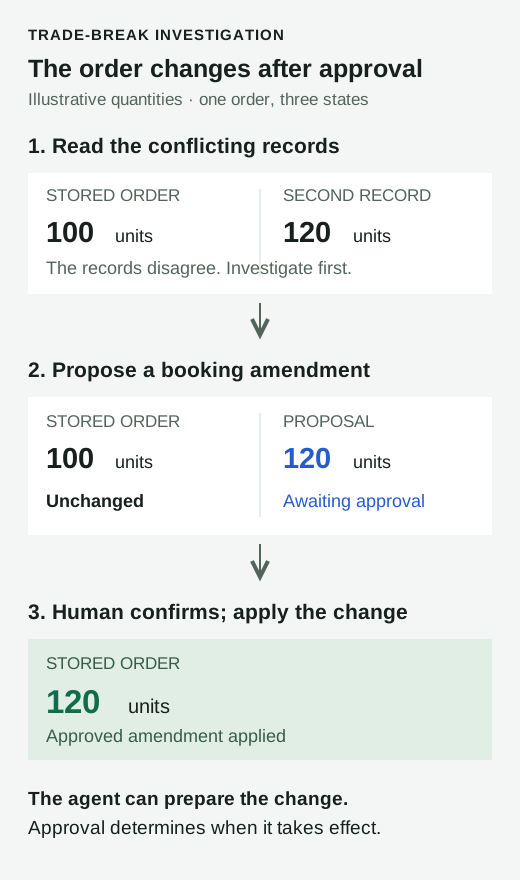
40:45In this case, a trade break agent is meant to look at two records
40:49of a single trade that don't match.
40:52And here you can see steps one through three.
40:54a little bit of a simplified version,
40:56but this is the business context that an SME provides.
40:59And we think about skills as living, breathing, versioned code, essentially,
41:05even though they're just plain text.
41:06They're meant to be dynamic.
41:08They're meant to be updated frequently.
41:13So now we have our context layer for the agent.
41:16We have the agent having access to our source systems and data.
41:20We have the agent that understands how to go from a generalized model to a specialized agent with skills.
41:27Now we want to talk about building the trust layer with that agent.
41:31And first, let's start with the identity and permissions layer.
41:34So here you can see the identity of the agent.
41:37We're going to assign it.
41:38It's going to be the trade break investigator.
41:40We're going to give it a role with permissions called ops analyst.
41:43And you can see here, once that agent needs to go and reach our source systems,
41:47like our order data and our market data, it'll have permission to read.
41:50But if it tries to go reach for our CRM data, it'll be denied.
41:54And we will do that on purpose so that it won't overreach for sources of data that it shouldn't have access to.
42:00And lastly, we don't necessarily want this agent to perform on behalf of us.
42:04We want it to just propose new amendments to our orders data, not actually make those amendments.
42:09And that's where we'll look at on the next slide how we can keep the human in the loop here.
42:15All right. So this is kind of the layer of who signs off before the agent acts, right?
42:21Many of you have heard the term sandbox. We can use that terminology here as well
42:25for putting an approval layer around the agent so that you can see here the four-step process.
42:32The agent will actually go and propose a booking amendment. It'll actually try to
42:37proceed through the process with the context that it has and the source systems and data
42:42that it has access to, but then it'll look for a human, an SME, someone in the loop,
42:47in the process, to approve.
42:50Once they approve, then that amendment will be made and the change will be applied.
42:55This is the layer where you can also put deterministic guardrails called hooks around your agent
43:01so that it's never overreaching beyond what you would like it to do within its confines.
43:09So now we have a full agent.
43:11Let's say it's in production.
43:14And let's say that we want to make an adjustment to this agent.
43:17Let's say that a new model is shipped,
43:20or we want to make an adjustment to the business context layer with the skills.
43:25How do we actually know if these adjustments are improving the agent
43:29or if they're causing a regression?
43:32So that's our evals layer.
43:34This is where your SMEs, your business users who are in the loop,
43:38who understand the process help determine a set of test cases
43:43to test the agent against with a benchmark or a baseline
43:47so that once you apply any change to any variable,
43:50you'll be able to determine whether that variable change
43:53actually improved the behavior of the agent
43:56or if it caused it to regress, as you'll see here in some of the examples.
44:03So hopefully you've seen, by building once,
44:07with a foundational layer that you trust,
44:10you can work at speed to deploy many agents at scale.
44:16For us, financial services and regulated industries
44:20It means that we're seeing a lot of innovation
44:22from the financial sector,
44:23and we're seeing it go hand-in-hand
44:25with security and safety as well.
44:28And those three layers that we just walked through,
44:31who the agent is acting as, who signs off,
44:34and how you still know that agent works,
44:36are the key components of building a safe and secure agent framework.
44:43And once you have this framework that you've built,
44:46you can use it to apply to any new agent that you want to build
44:49for any specialty use case.
44:51So you can see at the top, you'll have your foundation.
44:54And then at the bottom, you'll see where you can actually
44:56bring in more specialty along the way as you continue to scale.
45:01That specialty is worked in combination with the business and engineering
45:05to make sure that the proper business rules and context
45:09are being integrated into the agent workflow.
45:15And you might be wondering,
45:17we haven't mentioned anything like Claude Code yet.
45:19Well, everything that we've talked about so far
45:22has, let's say, four different doors
45:24that you can access it from.
45:25So a business person can access it from Claude Cowork,
45:29an engineer can access it from Claude Code,
45:32or you can take this to the next step
45:35and give the agent more work to do in your own UI environment
45:39via things like managed agents or agent SDK.
45:46Now, so far we've talked about building a secure,
45:51trustable agent foundation framework.
45:54Now let's talk a little bit about the operating model.
45:56Some observations that we've seen,
45:59especially in financial services,
46:01is that the business is now becoming closer to engineering.
46:05And the way that we're observing this is that the business will directly work with the agent that engineering has built.
46:11They'll have direct capabilities to correct that agent or amend it, propose adjustments,
46:17and that's where engineering is in the loop as well.
46:20Once you see the list of proposed adjustments, you can solidify that as a scale change
46:27after you've reviewed and tested all that within your eval framework.
46:31And then anything new that you ship goes right back to the business, and they'll go through the same loop again to continuously improve the overall agent and the process.
46:44So far we've talked about building the agent framework in a way that you can build once for scale.
46:51And we've talked about how you can turn a generalized, highly intelligent model into a specialized agent.
46:58Now I want to hand it off to Belinda to talk a little bit more about what we're seeing in the industry
47:02by building some of the foundations ourselves for the next step here, which is Claude for Financial Advisors.
47:11So what you've just seen is us building a foundation once in a firm.
47:15Now I want to talk about how we could take that same approach to our industry.
47:19This foundation we've built in Claude for Financial Advisors,
47:22and whilst you might not all in the room sit in the wealth or the advisor space,
47:26I want you to take this as a pattern and an opportunity to start to think about how we can actually coordinate at an industry level.
47:33So in September, we launched Claude for Financial Advisors, the orchestrator across the stack of an advisor.
47:38This was built on the foundation that advisors only spend approximately 20% of their time with clients.
47:44We wanted to find a way where advisors could spend more time with clients and more time growing their franchise.
47:51We went through the agent foundation and found ways to scale.
47:54At layer one, we brought connectors in.
47:58The industry system, the deterministic numbers,
48:01and the scaled system that advisors trust,
48:03we brought into the ecosystem.
48:05Layer two, we built skills.
48:07We built a plugin that is available on GitHub
48:10that builds eight skills and workflows
48:12that an advisor can take out of the box,
48:15use today, and amend for tomorrow.
48:17Layer four, approval.
48:19The advisor approves everything that comes out of Claude.
48:22Nothing is saved or sent without the advisor.
48:24and that trust principle holds here too.
48:27And so you can see here on the diagram on the left,
48:30CRM, market data, custodians,
48:32all the tools and foundations and advisor needs
48:34brought into Claude.
48:35So let's go through layer one, the connectors.
48:38We brought in 25 platforms across custody,
48:42portfolio, planning, data, and CRM,
48:45names such as Schwab, Adapar, Salesforce, and more.
48:49And there's more connectors that you can find
48:51on the Claude marketplace.
48:52This is where the industry builds once
48:54the advisor can integrate once, and this is what compounding looks like.
49:00These are the workflows we built for the advisor
49:03that they can start with and adjust and amend to their own firm.
49:06For example, pre-meeting prep allows an advisor
49:09to bring a full family plan into one brief across multiple systems.
49:13The follow-up allows the advisor to bring those meeting notes,
49:17enter them into the CRM system,
49:19and actually follow through the existing systems and tools.
49:23Nothing goes out until the advisor approves it.
49:26And this skill foundation is a baseline
49:27of which we imagine advisors will start to innovate
49:30and bring Claude into more and more of their workflows,
49:32allowing them to drive impact in their business.
49:36So, in closing, with 28 seconds on the clock,
49:40three questions to take to your firm today.
49:43The first one is the workflow.
49:45How are you applying the frontier intelligence to your firm?
49:48How are you gaining edge and alpha from the frontier models today?
49:52The second is the foundation.
49:54Do you all have a foundation that you trust
49:57for building and scaling agents for the future
50:00as things become more and more specialized?
50:02One connector. How are you actually building the foundations that others can use? Are you building connectors and skills for your users, for your firm, and for the industry?
50:12With that, thank you so much for having us. Enjoy the rest of the conference.
No passages match. Try a shorter word or phrase.