
New York · October 13, 2026
The talks.
The details.
The October 13 livestream, ready to watch, read, and revisit. Explore each talk with a reading edition and a searchable transcript.
Explore 26 sessions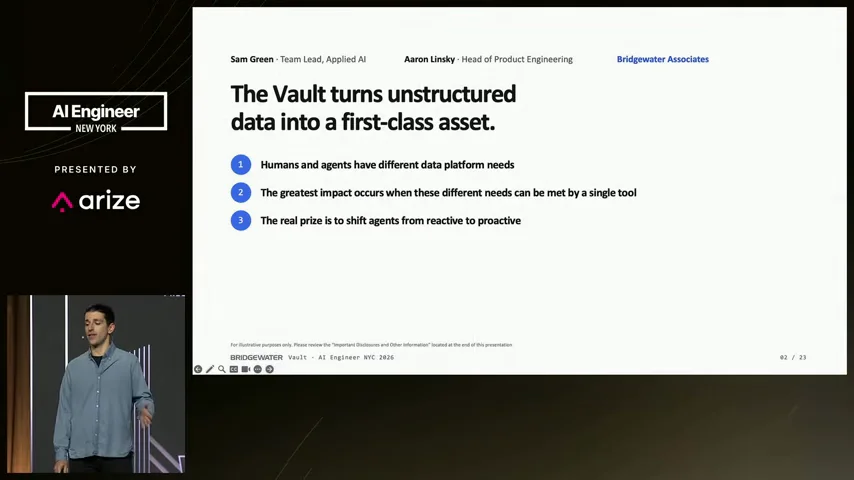
Vault: Making Unstructured Data Work for Investing
Aaron Linsky, Sam Green
All sessions
 6 min
6 minOpening & closing
Opening Remarks
Lia McBride, Alex Lieberman
AI engineering meets Wall Street: a room of builders comparing what already works, and what might become normal next.
16 minMain stage
Vault: Making Unstructured Data Work for Investing
Aaron Linsky, Sam Green
Investment agents need the research an investor would read—and a way to remember what the firm learns. Bridgewater’s Vault puts both into the same research loop.
 18 min
Main stage
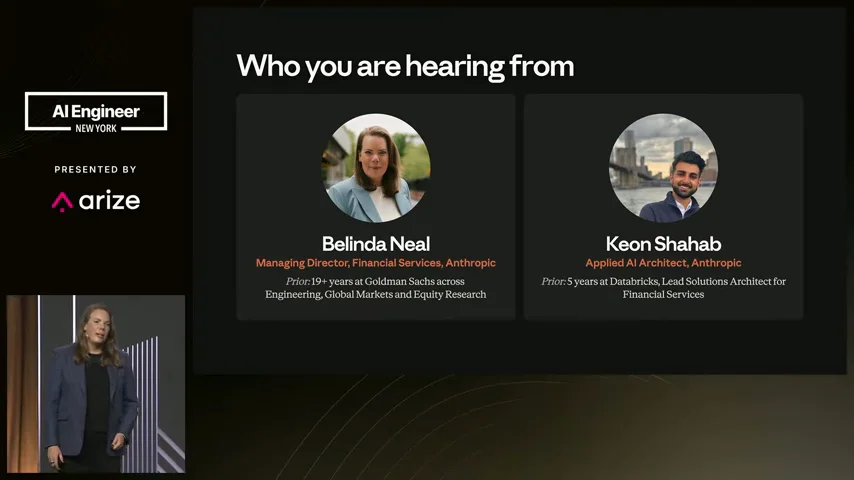
Anthropic: Accelerating frontier AI in Financial Services.
Belinda Neal, Keon Shahab
A trade-break agent can investigate a discrepancy without having permission to change the order. Belinda Neal and Keon Shahab show how to reuse that separation across financial workflows.
 19 min
Main stage
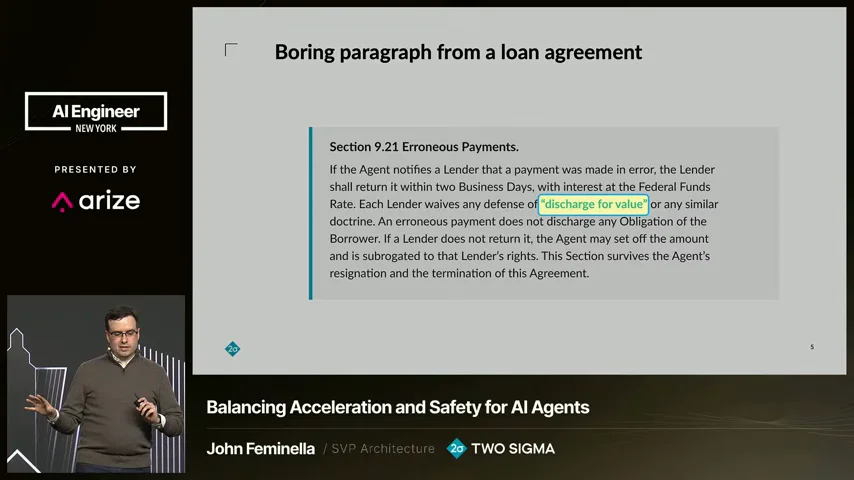
Balancing Acceleration and Safety for AI Agents
John Feminella
John Feminella uses a catastrophic payment mistake to explain five controls that make agents visible, constrain their access, and reserve human attention for decisions that need it.
 16 min
Main stage
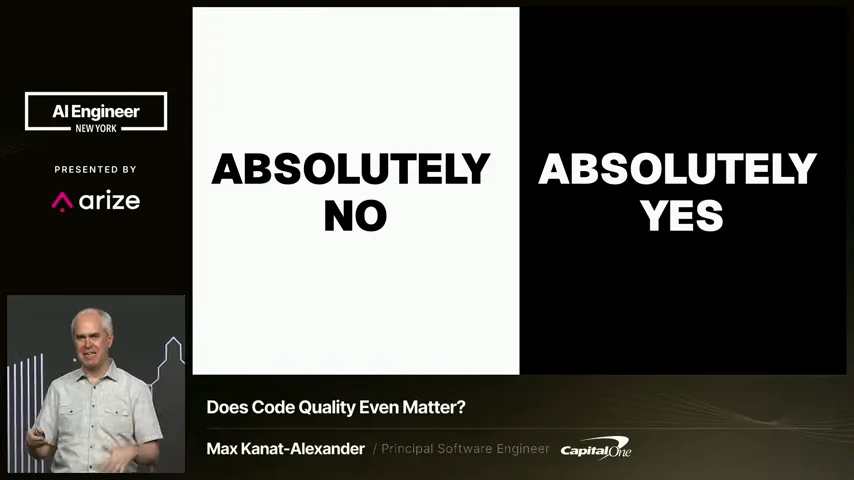
Does Code Quality Even Matter?
Max Kanat-Alexander
Cheap code makes some programs disposable. For the systems people will keep changing, Max Kanat-Alexander argues that AI should make engineering rigor cheaper too.
 15 min
Main stage
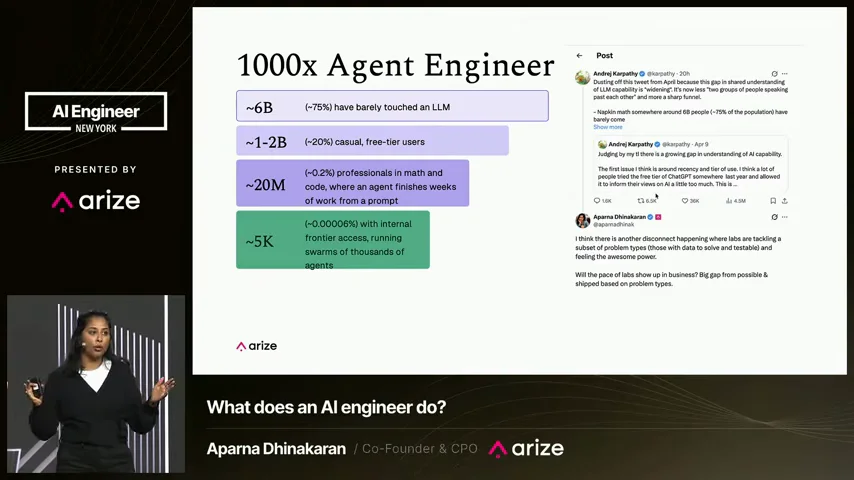
What does an AI engineer do?
Aparna Dhinakaran
Arize Signal reads traces, finds recurring problems, and can propose fixes. Building that loop requires decisions about memory, temporary access, recovery, and what counts as a good fix.
 18 min
Main stage
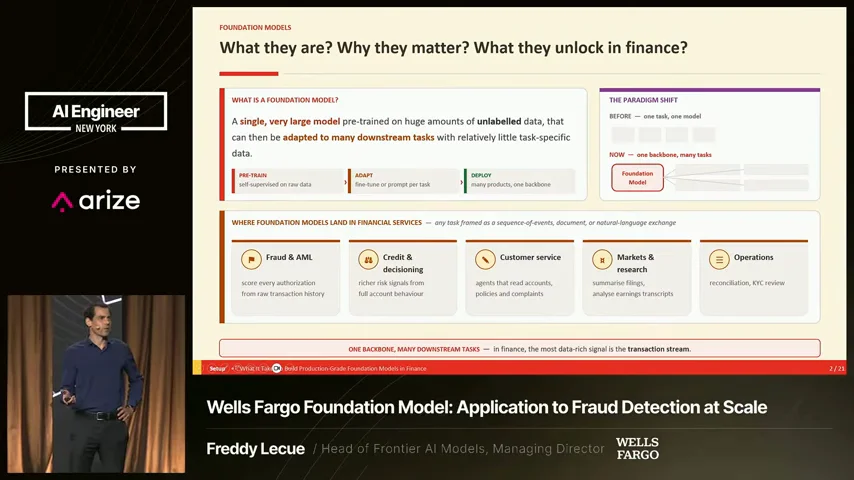
Wells Fargo Foundation Model: Application to Fraud Detection at Scale
Freddy Lecue
Freddy Lecue explains why Wells Fargo trained a transformer on transactions rather than text, how it tokenizes heterogeneous banking data, and how the resulting representation supports fraud detection.
 13 min
Main stage
Inside Arca’s long-horizon agents that run the business
Aman Singh
Aman Singh follows one client’s tax payment across days of analysis, approval, trading, and settlement to show how Arca’s agents keep work moving between human decisions.
 43 min
Main stage
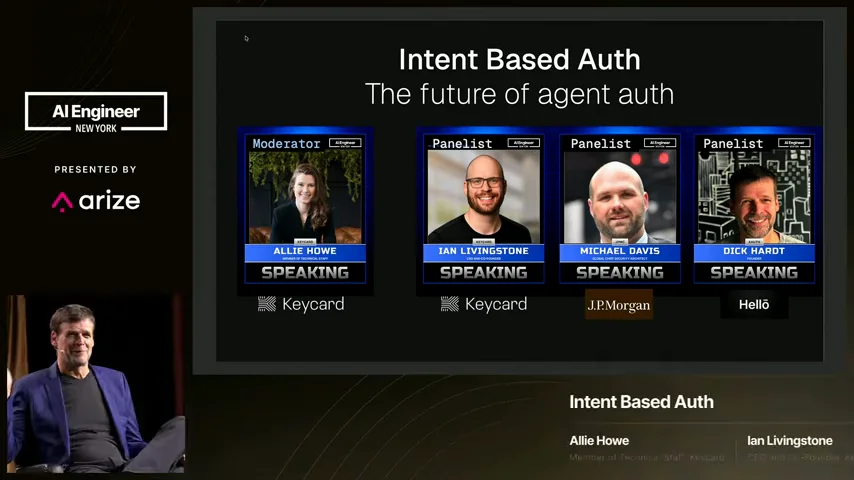
Intent Based Auth
Allie Howe, Ian Livingstone, Michael Davis, Dick Hardt
Permission to call a payment API cannot tell an agent whether it should pay this invoice again. This panel explores how mission history, budgets, and changing conditions can inform each authorization decision.
 9 min
9 minOnline track
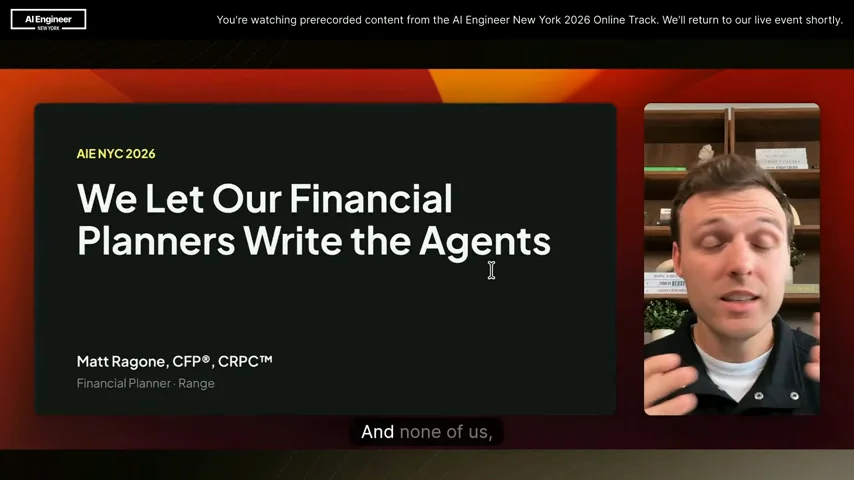
We Let Our Financial Planners Write the Agents
Matt Ragone
At Range, financial planners write and maintain the skills that draft their work. Matt Ragone explains how to turn professional judgment into a repeatable process without handing client communication to an agent.
 25 min
Online track
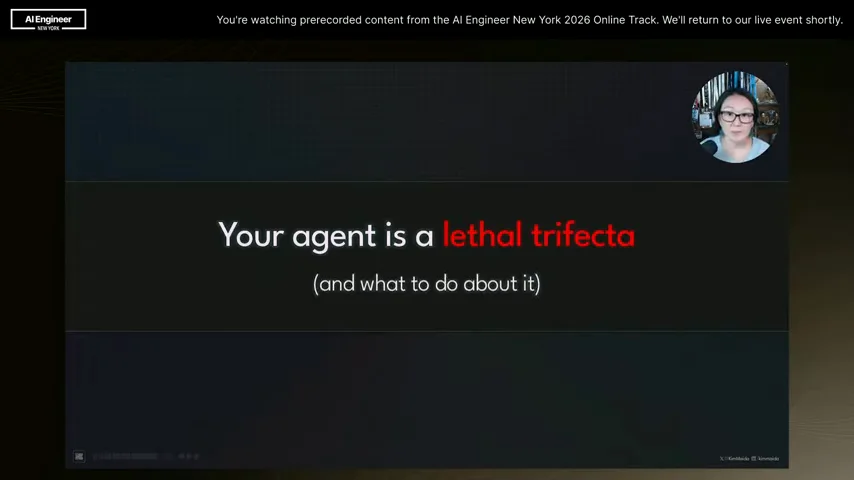
Your Agent Is a Lethal Trifecta (and What to Do About It)
Kim Maida
An on-call agent can be useful and dangerously overprivileged at the same time. Kim Maida follows the same incident queue before and after adding identity, token exchange, and task-scoped policy.
 13 min
Online track
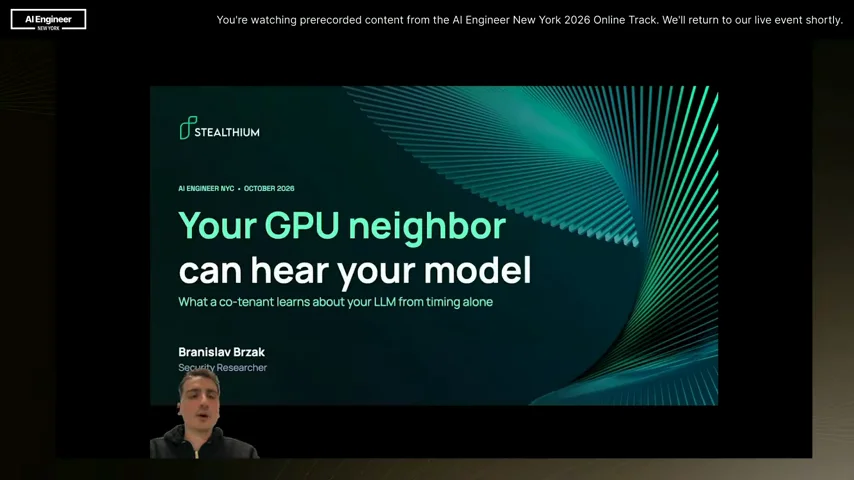
Your GPU Neighbor Can Hear Your Model
Branislav Brzak
Branislav Brzak demonstrates how timing on shared GPUs can reveal model behavior even when memory and compute are partitioned, then explains what operators can control.
 13 min
Online track
Please… Enough with the Sloppy, One-Shot SaaS Replacements
Mahmoud Abdelwahab
A working internal app can still be unpleasant to use. Mahmoud Abdelwahab walks through the product details, reusable patterns, and verification loop behind Railway’s agent-built marketing tools.
 21 min
Online track
Just-in-Time Ontologies
Hrishi Olickel
The meaning of a customer depends on the decision being made. Hrishi Olickel explains why data pipelines need contextual schemas, distinct model roles, and bounded experiments that can trade cost against quality.
 15 min
Online track
Building Reliable, yet Smart Workflows for Finance, Wealth and Insurance
Karthic Rao
A request to complete one form can become a process lasting days. Karthic Rao follows that request through Perpetual’s compiler, approval gates, and typed model calls.
 2 min
2 minOnline track
Agents in Orbit: Workflows, Not Autopilot
Eduardo Simon, Javier Casal
Flywire’s Orbit brings engineering agents into an existing GitLab and AWS environment. This opening excerpt covers the company’s infrastructure and privacy constraints before the livestream returns to the live stage.
 14 min
Main stage
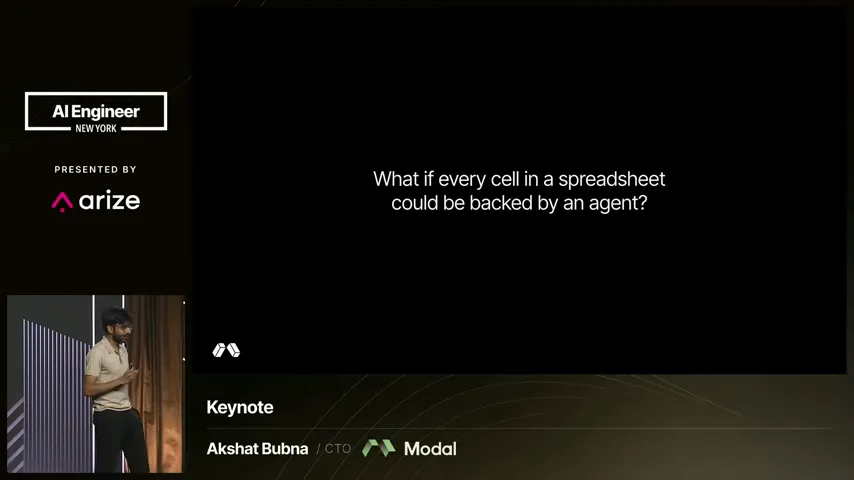
Great Agents Start with Great Infrastructure
Akshat Bubna
A spreadsheet with an agent behind every cell needs fast compute, shared storage, and deliberate isolation. Akshat Bubna explains how those requirements change the sandbox beneath an agent.
 10 min
Main stage
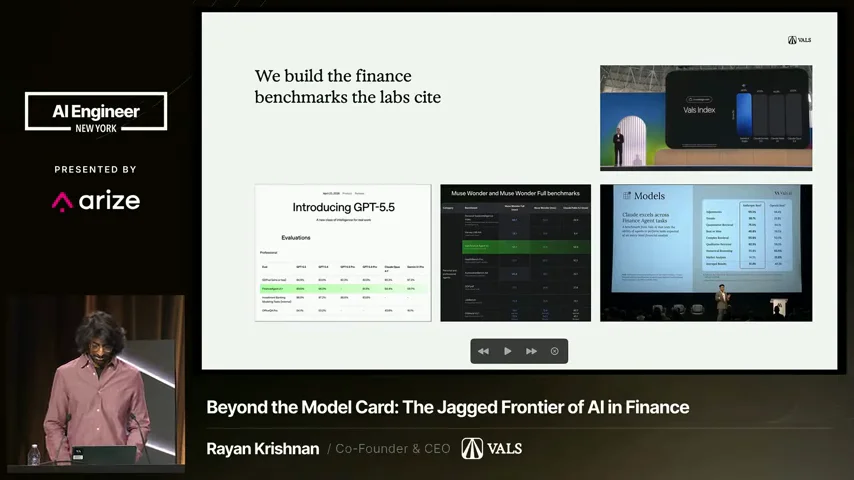
Beyond the Model Card: The Jagged Frontier of AI in Finance
Rayan Krishnan
A model can earn strong partial credit and still produce work that cannot be sent to a client. Rayan Krishnan shows how evaluations built from a firm’s own work can guide model choice, spending, and deployment.
 6 min
6 minMain stage
AI and the Future of Fundamental Investing
Jack Woodruff, Vinoo Ganesh
Jack Woodruff sees AI changing research preparation and analysts’ roles while leaving a central investment problem intact: deciding where limited human attention can uncover a divergent view.
 12 min
Main stage
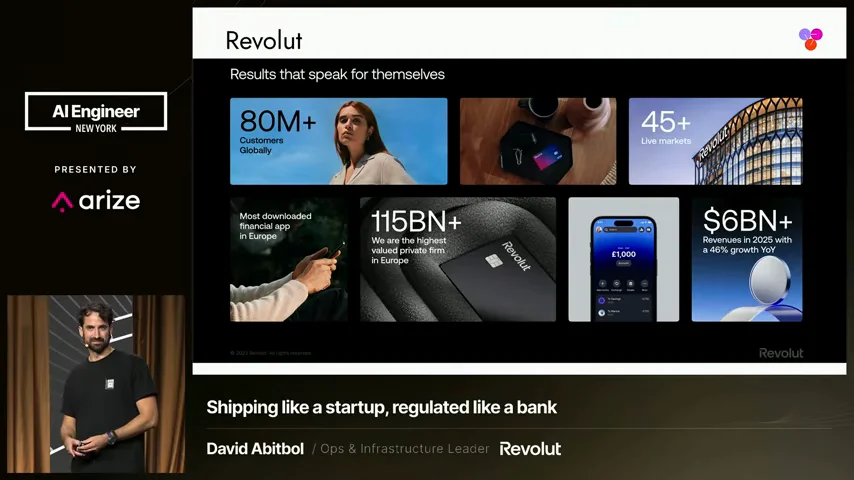
Shipping like a startup, regulated like a bank
David Abitbol
David Abitbol describes Revolut’s move toward self-hosted coding models, the inference tuning that made them practical, and the operational controls used around a regulated engineering organization.
 18 min
Main stage
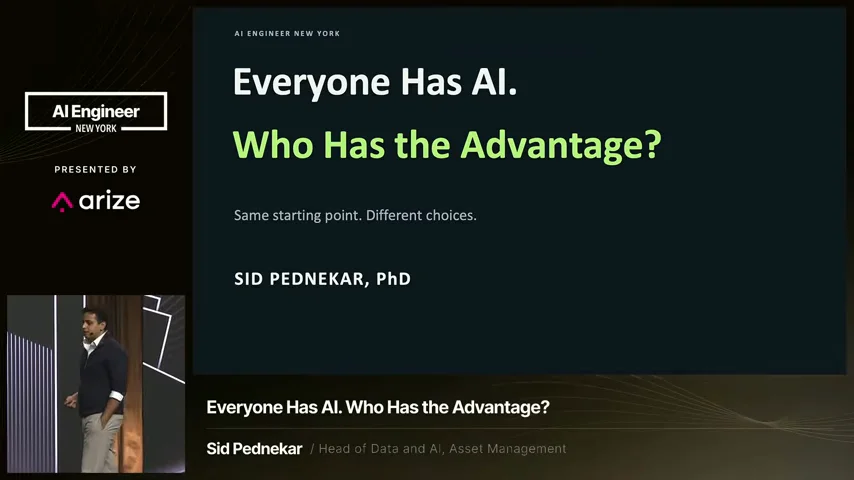
Everyone Has AI. Who Has the Advantage?
Sid Pednekar
Sid Pednekar follows two hypothetical investment firms to show why widespread access to AI can still produce very different results: the scarce resource is the judgment that shapes the work.
 5 min
5 minOpening & closing
Welcome Back - Featured Keynotes
Alex Lieberman
Alex Lieberman returns to the adoption gap: distributing an LLM is much more common than putting agents to work across a business.
 14 min
Main stage
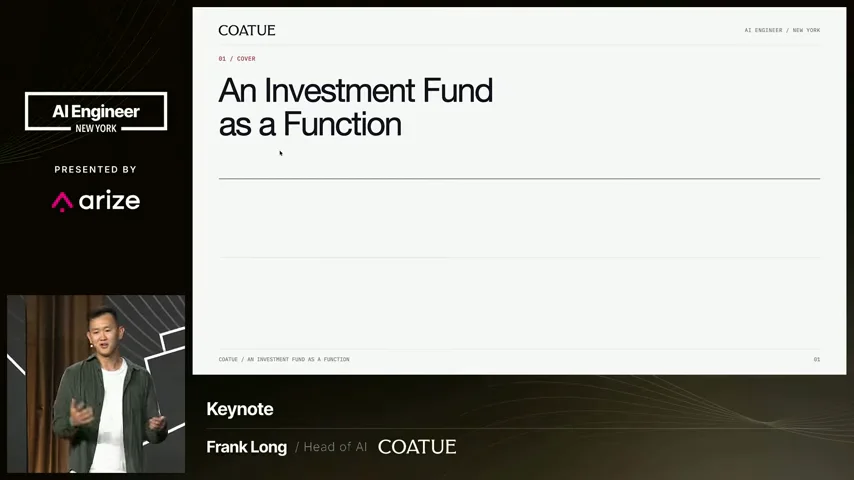
A Hedge Fund as a Function
Frank Long
Frank Long models an investment firm as a function that turns external and internal context into selection, size, and timing. The engineering challenge appears when that function is decomposed into work that code, models, and people can each perform well.
 19 min
Main stage
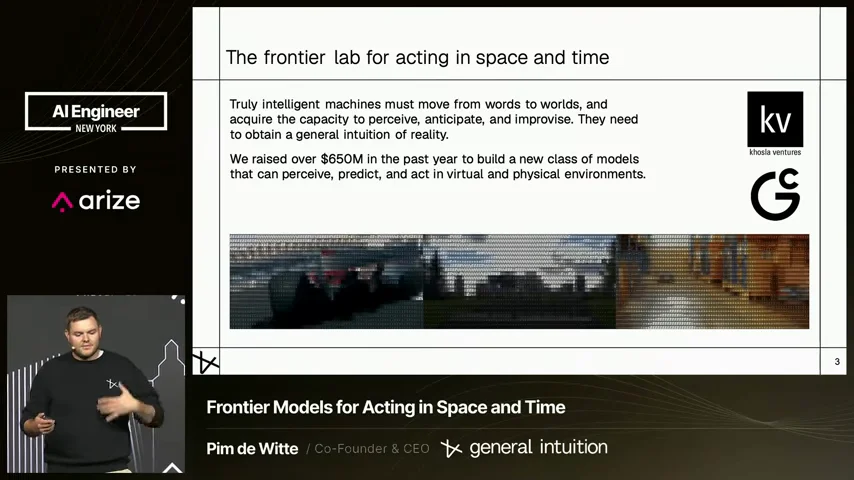
Frontier Models for Acting in Space and Time
Pim de Witte
Pim de Witte explains General Intuition’s bet on action-labeled game data: models that observe continuously and select actions while the world keeps moving, with language models available for longer-term planning.
 15 min
Main stage
Hermes gives you wings: Build on open foundations.
Dillon Rolnick
Dillon Rolnick makes the case for owning the agent layer as AI becomes part of everyday business operations. His argument connects model economics to a practical architecture: interchangeable models beneath software and workflows a company controls.
 1 min
1 minOpening & closing
Closing Remarks
Alex Lieberman
The closing invitation is simple: turn the day’s ideas into conversations with the people who are building them.
No matching sessions
Try a speaker’s name, a broader topic, or another track.