Timestamps follow the original livestream. Select a time to watch that moment. Transcripts are machine-generated with reviewed name and terminology corrections; occasional recognition errors may remain.
14:41Just waiting for our slides.
14:45Good morning, everyone.
14:46I'm Sam Green, team lead for Applied AI at Bridgewater Associates, and this is my colleague,
14:53and today we're here to talk to you about the vault, the data platform that we've built at
14:58Bridgewater to turn unstructured data into a first-class asset in our investment process.
15:04And as part of the talk this morning, we'd like to share three lessons that we've learned building
15:08the vault. The first is that humans and agents have very different needs from a data platform,
15:16and so you have to build for those different needs separately. The second is that the greatest
15:21impact occurs when a single tool can meet both of these sets of needs at the same time.
15:26And the third is that the real prize is when you can build the foundations needed to make
15:31agents a proactive participant in your investment process or whatever you're doing with your
15:37tools instead of a reactive tool for your humans to use.
15:44Before I dive deeper into talking about the vault, I wanted to start with some background
15:50Over the last 50 years, Bridgewater has been in the constant pursuit of the world's best
15:55understanding of how markets and economies work, and turning that into a systematic encoding
16:01that we can use to stress test our logic over time.
16:04And what originally began as a set of if-then rules on a yellow legal pad evolved into a
16:11continuous compounding process with humans at the center constantly looking for the next
16:15thing that's changing in markets.
16:17And more recently, we've been working on building AYA, the artificial investment associate,
16:22which puts a machine at the center of this continuous process.
16:26Across all these phases of evolution, we've had a constant philosophy in mind, which is
16:30that we want to be constantly looking at how the world is changing and what's going on
16:35in the world, noticing what dynamics are not yet encoded in our understanding, and use that
16:43learning to improve and compound for the future.
16:47For most of Bridgewater's history,
16:49that meant building and overseeing
16:51time series models on structured data.
16:54And that structured data needed to be carefully built
16:57so that it could be safe for use in our research process
17:00and aligned to our internal ontology and world model
17:03so that we could get great leverage
17:05out of using the data that we had built.
17:08With the emergence of language models,
17:10we had a huge new opportunity
17:11to engage with a much wider world of data,
17:16news and research, transcripts, policy documents,
17:19and all of the internal conversation
17:21that was previously just in the ether.
17:24So the internal memos and meeting transcripts
17:26and debate happening inside the firm.
17:28We quickly realized that all of that data
17:31needed the exact same treatment to be fit for purpose.
17:34It needed to be carefully cleaned, governed,
17:37and made ready for use in both point-in-time research questions
17:41today and also our systematic study over time. And when we looked out at the landscape of data
17:49vendors and data platform providers, there was nothing that provided us with all of the control
17:54that we needed to build and maintain our data advantage. And so we built the vault, which is our
18:02repository of external and internal unstructured data, and the platform that indexes, organizes,
18:09and makes all of it ready for use by our human investors and agents.
18:14Today, the vault has more than 100 million documents in it,
18:17with thousands more added every day, minute by minute,
18:20from 135 external sources, and again, growing all the time,
18:24as well as all of the data from inside of Bridgewater.
18:28And crucially, all that data is not just dumped on our investors' desks.
18:32It is carefully aligned to our internal ontology
18:36with enrichments like the countries, concepts, markets,
18:41and most importantly, time period discussed in the document.
18:46To bring this to life, I want to start with a quick motivating example.
18:50So what I did here is I asked a fairly basic representative investment question
18:56to an enterprise chat client.
18:58I asked, how is AI infrastructure investment impacting the Korean won,
19:02and do market participants expect this to continue?
19:05you. As you are all familiar with, the agent goes to the web and looks for resources it
19:12can draw on because I have explicitly asked it to go find other people's perspectives
19:18on the question. You can see it zooms in and finds 15 relevant looking resources to draw
19:25on before it gives me back its answer. When I zoomed in on the answer it gave back, a
19:31A couple of things stood out to me.
19:33The first is that even though it found 15 relevant-looking sources, it only picked one
19:38or two to answer my question.
19:41And the second is down at the end of this response, where the agent itself acknowledges
19:46that it hasn't answered my question.
19:48It didn't find enough documents on the open web to establish a market consensus and meet
19:54the parameters that I laid out.
19:56When I double-clicked even further, the problem got even worse.
20:01One of the notes that it primarily drew on to answer my question was published way back in July of 2026, even though I asked this question and captured this answer just at the end of last week in early October.
20:14In the age of AI and in investing, three months is a massive amount of time.
20:20It's not even close to good enough to draw on this resource to answer my question.
20:26When I ask this exact same query attached to the vault, something totally different happens.
20:32The first is that the connection to the vault helps to prompt the agent that it should look
20:37for a specific period of time when answering my question.
20:39So it zooms in on October 1st to October 8th.
20:41It finds a much wider array of resources, 52 candidate documents that are relevant to
20:48the query over this specific period of time because of the vault's much more significant
20:53corpus of content that's relevant to investing questions.
20:57when it ultimately answers my question, it draws on seven instead of only one or two,
21:03gives me back a rich answer that the agent is more confident is going to address my question.
21:10And so for us, this is the big lesson from building the vault to motivate the talk today,
21:15which is that it takes great data and the right connectors to make agents impactful.
21:20And I'm going to hand it over to Aaron now to talk about some of the product engineering
21:23takeaways from building the vault.
21:29I run product engineering at Bridgewater.
21:31I'm going to take us through a few of our learnings from building the vault over the
21:35I'm going to start with one that might seem obvious, but I still think it's worth saying,
21:40which is search is hard.
21:44But it gets even harder if we're designing for two different consumers.
21:48In this case, we're designing for humans and agents.
21:51I'm going to go over the difference here, starting with us.
21:54So humans need precision and a high signal-to-noise ratio because we can only read so much.
21:59Even a fast reader manages about 300 words a minute, and personally, I'm much slower.
22:06Agents are a different kind of reader.
22:09They're far less sensitive to precision.
22:11If the data is there, they'll find it.
22:13And basically anything you hand to them will get attended to.
22:17They scale super quickly and they consume about 100 times faster, 30,000 words per minute.
22:26And so we need to build Vault for both of these.
22:29And when we're thinking about the dimensions that matter, there are these five on the board.
22:34recall, precision, filtering, entitlements, and scale. Some of them matter to people,
22:41some matter more to agents, many to both. I'm going to go deep on three of these,
22:46precision for people, scale for agents, and then filtering for both. So, precision.
22:54Once we've filled the vault, which was a heroic effort by our data and legal teams,
23:01Recall was no longer a pressing issue.
23:03However, the number one complaint was vault search is bad.
23:07As a product owner, it's painful to hear that,
23:10but my response was, let's benchmark it.
23:13And that's what we did.
23:14We collected questions and found the best documents by hand,
23:18including ones that looked helpful but weren't.
23:21In total, it was about 200 examples,
23:23and it took us less than a week.
23:25It was not fun or very glamorous,
23:28but it was very helpful.
23:30And after we ran it, it was very clear.
23:34The key metric we were looking at is precision at 10,
23:37which is of the top 10 results, how many are the right documents.
23:42And we were hitting about 60%.
23:45So the people were right.
23:48But now we had a way to measure all of the improvements.
23:51And here on the board are five of them.
23:54And by the time we got done with agentic search,
23:56we were up in the 90-95% recall at 10, or precision at 10.
24:03All right, so that was precision.
24:05Now on to filtering.
24:07Like anyone, we want the most relevant documents.
24:11But when we looked at the production traces,
24:14what we were seeing is that almost always there was some condition,
24:17either as of a certain date or from a certain source
24:21or about a specific asset.
24:23And all of that requires advanced filtering.
24:26And that's where we ran into our first major performance issue.
24:31So I'm going to quickly go through this, a little bit technical here.
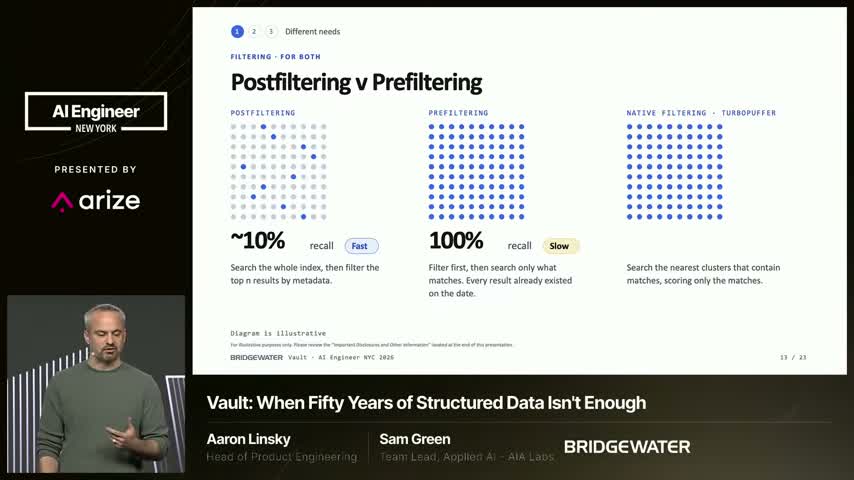
24:35There's classically two ways to filter a vector database.
24:40Post-filtering, we'll use that vector index first,
24:42and then filter the top results by metadata.
24:45It's fast, but recall could be pretty low,
24:48because the globally relevant results might not match your filters.
24:53On the other side, we have pre-filtering,
24:55where we'll filter first and then calculate distances for every one of those matches.
25:00The advantage there is that the recall is very good, but it can be very slow,
25:04and we needed something in between.
25:06So that's what led us to try and then ultimately switch to turbopuffer.
25:10Their approach, which they call native filtering,
25:12looks only in the nearest clusters that contain matches and then scores just those.
25:17What you end up getting is something that's fast, like post-filtering,
25:21but with close to the same recall as pre-filtering.
25:26Lastly, I'm going to talk about scale.
25:30scale for us is pretty pedestrian.
25:31100 queries an hour, we have 300 users, they're going to search every so often.
25:37It takes our users minutes to read the docs that they're receiving.
25:41Agents on the other hand are a few orders of magnitude beyond that.
25:46Easily 100 plus queries a second and agent swarms can hit thousands easily.
25:51And they obviously will read, as I said earlier, will read docs in seconds.
25:54So we needed something that could scale as well.
25:57And again, turbopuffer handled that easily too.
26:01So we were covering all five dimensions.
26:03I didn't talk about entitlements, but I'll be talking about that later today.
26:07But we covered it all.
26:08It unlocked new workflows.
26:11But it didn't change how our researchers worked.
26:14They still weren't coming to Vault every morning.
26:16And that's my second lesson that I want to share here,
26:19is that no matter how amazing the tools are,
26:22we can't just drop them on our investors' desks.
26:24and expect them to be used. We need to migrate their old habits into a new form.
26:31And so we looked at what they were already doing. Many of them were living in email.
26:37The research came straight from the brokers. They had subscribed lists. They had rules
26:41that filtered everything into folders. It worked. It was familiar. And they knew that
26:47they weren't missing anything. So we had to build all of these features into the vault.
26:52That's exactly what we did.
26:53Everything searchable, the subscribed lists became saved searches,
26:57and folders became saved collections.
27:00It's the same habits, just a new home.
27:02And once we had them there, we can open up new habits.
27:05So they can ask questions across all the data, as Sam showed.
27:10They can follow dynamic feeds by topic,
27:12and they can hand those collections over to their agents to take further action.
27:16And that's when we clearly had product market fit.
27:20And once we had that fit, the users wanted it everywhere, so we put it in chat, we made
27:25a phone app, it's in Slack in their IDE, and of course we availed all of that to the agents
27:29as well, including a CLI, because agents love CLIs.
27:35And so the main question here is, okay, so what does this enable?
27:39Sam's going to talk about what we're building right now, but first and foremost, it's helping
27:44us to move around that research circle faster.
27:47With our pocket analyst, which is our first AI analyst, it can do hours of research in just a few minutes for a few dollars, and that's relying on the Vault.
27:59And then we're expanding that now with the researcher, which is the next generation.
28:03It's the same idea stretched across days or weeks.
28:07We're also able to train custom models to more intelligently reason over the Vault's data,
28:12and use those together with other foundation models to feed systematic decision-making processes.
28:18The Forecaster is our first one, which produces AI-generated macro-relevant predictions.
28:24then we also have built investment signals from the Vault,
28:28turning unstructured data into structured, tradable strategies.
28:32Now I will hand it to Sam to take us through Vault's latest capability.
28:40like I alluded to at the beginning of the talk, the real prize is when you can take
28:45agents from a reactive resource that can be ready to answer a human's question and instead
28:51make them proactive participants helping to steer your high value professionals towards
28:57the most important areas for their attention.
28:59The way we're solving that problem is in an experience we're calling the investor workbench,
29:04where the agent is always on, tracking what's important to that investor and presenting
29:11them with the areas that are most in need of their attention.
29:15looks like an experience like this that relies on the vault, where a topic is proposed
29:20and several pieces of information are presented to the investor to decide whether they should
29:25dig deeper or ignore that topic entirely.
29:28You can see here the card that an investor sees in order to decide whether to dig in deeper into the same AI impact on currencies question that we looked at earlier in the talk.
29:38And the investor receives everything they need.
29:41An agentic summary, if they want a quick scan across the agent's findings, they also get the exact evidence that the agent was drawing on, so they can assess for themselves what was leading to this recommendation.
29:54And if they choose to dig deeper, they have a direct connection to the research output
29:58from the analytical tools that
30:00Aaron was just describing.
30:01And when they dig deeper alongside the agent to look at the dynamics driving this question, the learnings are automatically captured, the results of their collaboration are automatically captured back in the vault.
30:17And so this for us is the key lesson.
30:19The vault enables compounding because it provides the right evidence, the right internal and
30:25external information at the fingertips of our investors and agents, and it automatically
30:29captures the synthesis that they generate and puts it back in the corpus for the next
30:35And that makes us go around the circle faster and better.
30:39And so when we think back to the question we began with, what it takes to make an agent
30:44work is the right context and understanding of what's going on in your world.
30:49Our question for you is, does your AI know what's going on in the world and does it remember
30:53what your firm has learned about it?
30:55Because we are teaching ours too.
30:57And if these sound like an exciting challenge, we'd love to talk.
No passages match. Try a shorter word or phrase.