Timestamps follow the original livestream. Select a time to watch that moment. Transcripts are machine-generated with reviewed name and terminology corrections; occasional recognition errors may remain.
6:28:41Good afternoon, everyone present here.
6:28:45It's been a great day and an absolute pleasure to be here.
6:28:52The topic of my talk today is everyone has AI, who has the advantage?
6:29:00I'll be talking about what the orgs that are doing, that are leading in AI with their implementation and adoption,
6:29:09what are they doing differently?
6:29:13so before that, who am I and what's my POV?
6:29:18So I'm Dr. Sid Pednekar. I am an AI technology and data exec in asset management.
6:29:26I've spent most of my tenure in hedge funds and investment in academic research.
6:29:34What I've done and focused on is lead strategy and build specialized teams towards three main verticals,
6:29:42optimizing efficiency, driving PNL, and reducing costs.
6:29:49So I'll be following the discussion along with two hypothetical companies,
6:29:56Company A and Company B, right at the slider below.
6:30:00These are hypothetical, you know, with made-up workflows, but we'll be following their journey along the rest of this presentation.
6:30:12So, everyone has AI. Who has the advantage?
6:30:17Before we get started there, first let's see what the lay of the land is.
6:30:22And recent studies have shown that only about 37% of enterprises that were surveyed are
6:30:31showing a positive contribution to their EBIT.
6:30:35And only about 6% of those would be qualified as high performers.
6:30:41So that's about 5% contribution to their EBIT.
6:30:44Other studies earlier in the year have shown that about 66% are saying they're having a productivity increase,
6:30:53but only about 40% and 20% are actually seeing cost reductions and revenue growth.
6:31:00So as we know, access of AI is widespread, yet the impact remains uneven.
6:31:11So, the question I would ask, or how I think about this, is really in terms of three verticals.
6:31:21And the way I think about these three verticals should apply to organizations and individuals
6:31:28alike, and it should apply to functions, regardless of where you are in that organization.
6:31:37So the three main vertical pillars that I think of are, number one, design the right problem.
6:31:45Number two, build shared capabilities.
6:31:48And number three, compound the advantage.
6:31:52Now before we dive into each of these pillars, there is an idea that I think goes through all these verticals.
6:32:01And I think the best leading firms are taking advantage of that and capitalizing on it.
6:32:08As we know, throughout time, the only constant in this world has been change.
6:32:14What's different in the AI and superintelligence era is that intelligence has become cheap.
6:32:21Regardless of what your unit of intelligence is, whether it be software, analytics, recommendations, reports,
6:32:30AI is creating an abundance in all of it.
6:32:32And as we know, more answers don't necessarily create more value.
6:32:42What is the scarce resource in an abundant world?
6:32:47What are companies taking advantage of, the leaders at least?
6:32:57Judgment is choosing what matters and how to act
6:33:00when there's no single obvious answer.
6:33:02It's the creativity that lets you explore what possibilities are worth exploring.
6:33:07It's the taste that tells you what good looks like in your given context.
6:33:12It's the decisions where you can weigh what trade-offs are worth making.
6:33:22It exists throughout your organization on a daily basis.
6:33:26Your C-suite, the C-suite is asking questions, taking advantage of judgment all the time.
6:33:31So are the software engineers, the AI leaders, the portfolio managers, and the data scientists.
6:33:38So the question that they're focused on is, given judgment is a finite asset, a limited capacity,
6:33:49the main question becomes, where is our best judgment worth spending?
6:33:54I'd like for you to hold on to that thought.
6:33:57With that, we'll dive into our first pillar.
6:34:02So questions, a question that the leading organizations are asking all the time is they're obsessed over what is the right problem to solve, right?
6:34:15It's tempting to start with a tool.
6:34:17Today we're surrounded with better models, harnesses.
6:34:22We're surrounded with all these AI tools.
6:34:23We're surrounded with co-pilots.
6:34:26But that isn't the way about, is it?
6:34:29At least that's not the way the leaders are approaching it.
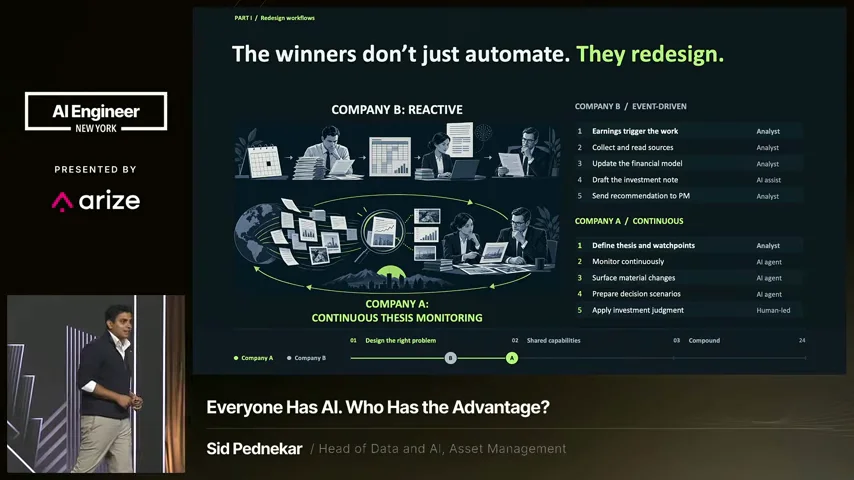
6:34:31Now, let's go back to our hypothetical two companies.
6:34:35Let's say they're from asset management.
6:34:37Let's say we're tracking the workflow of two research analysts
6:34:41in these hypothetical organizations.
6:34:45Well, let's say organization B starts with the tool, the co-pilot.
6:34:51They're asking, where can we add AI to the analyst's work?
6:34:55They're looking at the current existing process to say,
6:34:59earning transcript comes in, I discovered a summarization workflow, let me pass all of
6:35:05this in through my fire hose, analysts get earning summaries faster, win-win, right?
6:35:13Well, not so much, at least not compared to the guys who are leading.
6:35:17And such a workflow of being a faster horse introduces one key nuance.
6:35:23That is, you are losing context as you have information, I guess, reduction as part of your summarization.
6:35:31So what is a hypothetical organization A doing in this?
6:35:36Well, they're obsessed on the right problem to ask.
6:35:39They could be asking, why are our material signals reaching us too late?
6:35:44Where do we focus the attention, the AI, the bandwidth, the capability on?
6:35:49Where is our bottleneck, right?
6:35:51And so it becomes this redesigning of the workflow,
6:35:54or at least a re-evaluation on what to focus on.
6:35:58That's what they're doing different.
6:35:59Now, this consideration isn't particular to finance.
6:36:02It's across the realm and function.
6:36:05You're asking the same question on what to focus on,
6:36:10whether it be research capacity, decision speed,
6:36:13quality of your data, latency, reliability.
6:36:22They show leading studies, on average,
6:36:26spend their attention on fewer higher quality decisions
6:36:32So leaders are being more selective
6:36:34in where they focus their attention
6:36:36and what they focus their attention.
6:36:40The leading companies have an idea
6:36:43of what the right problems are.
6:36:45Where do they go from there?
6:36:47Well, they also concentrate their investments in the highest value workflows.
6:36:54I get it, and I've been culpable of something similar,
6:36:58where AI is almost creating too many opportunities.
6:37:03And experimentation can be a good thing.
6:37:06But one needs to separate experimentation and the resulting innovation theater,
6:37:11or worse, the productivity theater, which actual value generation.
6:37:17Going back to our two hypothetical companies, what does this mean?
6:37:21Company B is looking at how do we launch the most number of AI pilots?
6:37:26And what that ends up looking like is a document summarization bot here,
6:37:31a co-pilot there, a data retrieval bot here.
6:37:35It's scattered all over the place.
6:37:37whereas what company A is focused on in their investments
6:37:41is potentially use cases like end-to-end workflows
6:37:50They're focused on aligning engineering, analytics, AI, capacity,
6:37:55and judgment towards a singular focus.
6:37:59And research has shown that the leaders spend more than 80%
6:38:05of their investments on these high-value use cases,
6:38:10transforming key business functions
6:38:17We know they're focusing on finding the right problem,
6:38:21and they're also spending deep investment
6:38:26Well, they're also doing something different.
6:38:29They're reimagining how work is done.
6:38:35And it goes back to what we discussed previously, which is judgment.
6:38:40They're redefining and reorganizing functions, roles, capacities
6:38:44around this key element of judgment.
6:38:48What does that mean for our hypothetical company?
6:38:51Well, company B might be focused on, as we discussed,
6:38:55I'm getting my earnings transcript, I'm getting my research reports.
6:38:59How do I summarize it? Maybe I make that faster.
6:39:02Maybe I update my financial models faster.
6:39:04Maybe I send my recommendation to my PM faster.
6:39:07Company A is focused on an entirely different ballgame.
6:39:13Hypothetically, they could be asking the analyst to define the investment thesis,
6:39:16and they're watching and gathering evidence that could refute that thesis or support it.
6:39:22They'd be monitoring continuously, they'd be investigating exceptions,
6:39:28and they could be deep diving on select examples
6:39:35that could lead to actual generation of value.
6:39:39So the winners don't just automate, they redesign.
6:39:43studies show that the cohort of high performers
6:39:46are 75% more likely, or in practice,
6:39:49they actually do redesign their workflow
6:39:51versus 25% of the cohort that doesn't.
6:39:56So where does this leave us with our two hypothetical companies
6:40:00and designing the right problem? Company B adds AI to existing workflows, they're completing individual projects and they're moving to the next initiative, whereas Company A is rethinking how work is done. They're redesigning processes around AI and they're obsessing over the right problem. That's the difference in how organizations put AI to work.
6:40:23Great, so they've picked the right problem.
6:40:28Well, we all know in order to actually enable that capacity,
6:40:31you need to build share capabilities across the org.
6:40:36And what's a trend that's seemingly emerging for some time now
6:40:41is that the lines between technology and business are converging.
6:40:46And we're seeing this everywhere.
6:40:48We're seeing engineers that are moving closer to business outcomes.
6:40:51We're seeing business professionals that are building tools and automations.
6:40:55And as you can see and imagine, you can have forward deployed engineers,
6:41:00you can have forward deployed product managers,
6:41:02but you could also have the inverse, which is forward deployed portfolio managers.
6:41:07And it's really this combination of getting the right people in the room
6:41:12by breaking down organization silos that the leaders are really leaning on.
6:41:20studies have shown that more and more of the large enterprises are viewing their technology arm as a business growth function
6:41:28and that's creating an edge for these companies
6:41:34so the other sort of vertical inside building shared capabilities that is probably a personal favorite of mine
6:41:42it's standardizing the core and personalizing the edges
6:41:47And this is something that isn't new to the technology world.
6:41:52We've built shared modules and system design.
6:41:55But what's interesting here today is that's taking a very different shape with the capabilities out there
6:42:01and with the org and the breaking down of silos.
6:42:04And this could look very different depending on where you sit.
6:42:09You could be building shared cores
6:42:11for a team that looks very different
6:42:16You could be doing that with a bunch of analysts,
6:42:19or you could be doing that for software engineers
6:42:24With the data scientist example in particular,
6:42:28that could look very interesting
6:42:29where instead of having one-off workflows
6:42:34that is really common in the industry,
6:42:36you could build a shared core
6:42:38of the data sets, their semantic layers,
6:42:41the trade-offs of what worked, what didn't,
6:42:44what some data sets do good of,
6:42:47where are the gaps, and so on and so forth,
6:42:49such that each new personnel
6:42:52becomes almost a plug-and-play module
6:42:55in the system where they can then stand
6:42:58on the shoulder of their predecessors.
6:43:01So what should the next person not have to rebuild?
6:43:05now what's also interesting is um you know the enterprise wasn't really built for agents um agents
6:43:13they they work across workflows and applications they they take context they uh deliberate they
6:43:20take actions whereas really the enterprises are focused um previously on a single human
6:43:27or a collection of them interacting with a single application.
6:43:31So the leaders are cognizant that something needs to change
6:43:35and that they need to modernize their infrastructure.
6:43:38And they're very self-aware of where they are in their journey.
6:43:43And so studies show that 71% of the orgs
6:43:48are modernizing their core infrastructure to support AI.
6:43:52and 6% to 10% or 23% of them are investing 6% to 10% of their annual revenue
6:43:59in core system modernization to take advantage of this.
6:44:03And a common complaint here or a common challenge here is data quality
6:44:09and the ability to reuse data.
6:44:13So, great. We have the right people in the room.
6:44:16We have the right knowledge there.
6:44:23And then comes the concept of, hey, how do we make this knowledge reusable and accessible?
6:44:28And that's where we have, depending on the adoption and where they are, you can have different types of team agents,
6:44:35where you can have expert agents being subject matter experts.
6:44:39You can have workflow agents that work across streams like Slack bots that are creating and opening tickets.
6:44:45they're closing them, and what have you.
6:44:48And then you can have really chief of staff kind of agents
6:44:50that keep a tab on what the state of the organization is
6:44:56So, you know, going back to our workflows,
6:44:59A, again, is looking at this very differently
6:45:01in terms of shared capabilities.
6:45:04Now, the last pillar here that I want to draw your attention to is,
6:45:09well, when does this system really compound?
6:45:12What happens when it's deployed?
6:45:16Well, the leading companies, what they're doing is they're actually thinking about it slightly differently.
6:45:21What are failures that can give us an edge that we can learn from?
6:45:26If there's a success, how do we make it part of the system?
6:45:30And the way they think about this is, you know, the individual learned but did the system.
6:45:35Is there a way, perhaps, when they've encountered something where they need to make a correction,
6:45:39that that knowledge is fed back into the org,
6:45:42either through a new tool or context or what have you.
6:45:46And what's key here is preserving the evidence along with those learnings.
6:45:54So really the last vertical here is AI freeze capacity.
6:46:01Being cognizant that you need to redesign your system
6:46:05and really focus it on key metrics that you're evaluating,
6:46:11you're monitoring, and you're creating a flywheel off.
6:46:15So where does this leave us for companies A and B?
6:46:19You know, company A has their entire work redesigned.
6:46:23They're building capabilities at Compound,
6:46:25and they have shared capabilities built.
6:46:29So I want to leave you off with one final question.
6:46:32Everyone has AI. Who has the advantage?
No passages match. Try a shorter word or phrase.