Timestamps follow the original livestream. Select a time to watch that moment. Transcripts are machine-generated with reviewed name and terminology corrections; occasional recognition errors may remain.
1:27:23Well, welcome to AI Engineer.
1:27:26I thought given we're at AI Engineer New York, we'd kind of revisit the question of what
1:27:33I feel like every year we have an idea of what an AI engineer does, and that definition
1:27:41And as I was putting this talk together, it was super timely because Karpathy actually
1:27:45just tweeted something this weekend where he kind of talks about this growing gap between
1:27:53basically folks at the frontier who are running thousands of agents and swarms of always-on agents,
1:28:00and he really kind of drops this funnel where 6 billion-plus users have maybe touched or
1:28:06interfaced with an LLM, 1 to 2 billion are maybe like casual free-tier users, 20 million are
1:28:12professionals who have maybe started using it for more, taking some piece of work that
1:28:18would have taken weeks down to days.
1:28:21But really, those at the Frontier Labs, which is a super small percentage, it's like 5,000
1:28:27users, are the ones who are running thousands and thousands of agents at once.
1:28:35And as I look at this, it really is, I mean, he's kind of dropped a bit of the funnel.
1:28:39I mean, the first question anyone looks at this is that, where am I on this?
1:28:43And, you know, he's kind of drawn out a bit of a roadmap of how does everyone get to, in the next couple of years, one of those 5,000 users who are running thousands of agents.
1:28:55And this has been happening, I'd say, for a couple of decades now, where the abstraction layer has gotten higher and higher.
1:29:01I mean, definitely faster in the last couple of years, but we've gone from engineers writing higher level abstraction languages to, I mean, just copy pasting code, using local agents to using cloud agents to really the expectation now is how do all of us start running a team of agents or factories of agents internally and build toward that?
1:29:28And what this has led to is essentially what is the then and now of what an AI engineer
1:29:33And this is a bit, I think, of a roadmap for some, but I think internally this is what
1:29:41we've already started to kind of push towards.
1:29:44As an AI engineer, your job is no longer to just write the feature, write an AI feature,
1:29:48it's about how do you build the loop to write that feature.
1:29:51It's no longer about just reading the diff and actually doing code review.
1:29:57It's actually how do you set up systems and agents to
1:30:01And how do you write evals to actually do the non-deterministic, to review those non-deterministic tasks?
1:30:08It's actually no longer even about just setting up metrics and software kind of telemetry, but it's actually how do you have agents go through and read the observability data,
1:30:18and have agents actually consume that telemetry to find patterns?
1:30:23And so this loop that we've kind of been talking about, which is the build, the eval, ship, you monitor, you improve it, well, the AI engineer is now actually responsible not just for doing each of those steps, but how do you build the loop that actually does each of those steps?
1:30:40And at Arize, one of the things we've rolled out in our product, and I'm going to talk about a bit of what we've learned in building this, is we built Signal to actually run this loop for AI engineers.
1:30:50What Signal does is that Signal actually looks at all of the traces, it reads the telemetry,
1:30:57it identifies patterns in that telemetry, and it can actually put up a fix or a PR if
1:31:05And Signal is an always-on agent.
1:31:09So this is an example of how Signal starts, but it actually starts off by just reading
1:31:16Super simple example, but it goes through, reads,
1:31:19and all of this is configurable,
1:31:21but a certain volume of traces that came in in some cadence,
1:31:26it reads it, and then the goal is to actually identify issues
1:31:32It has to keep track of issues that it's previously seen.
1:31:35So we have to consider the memory of,
1:31:38it see something before that it thought was an issue?
1:31:41Did something seem like an issue, but it wasn't actually captured,
1:31:44and now as it collects more data, it actually thinks it's much more of a critical issue.
1:31:50And so Signal actually starts off by reading the traces to identify problems.
1:31:55so one of the first things that we realized was that the future of who's actually consuming telemetry data
1:32:05It's no longer about humans consuming telemetry data.
1:32:09It's not even about humans consuming it and agents kind of taking on the task,
1:32:13but it really is how do you set up your telemetry data
1:32:16so that agents are the primary consumers of that data.
1:32:20And what that does is that that observability data
1:32:23can become the trigger for actually running
1:32:26and triggering these always-on agents.
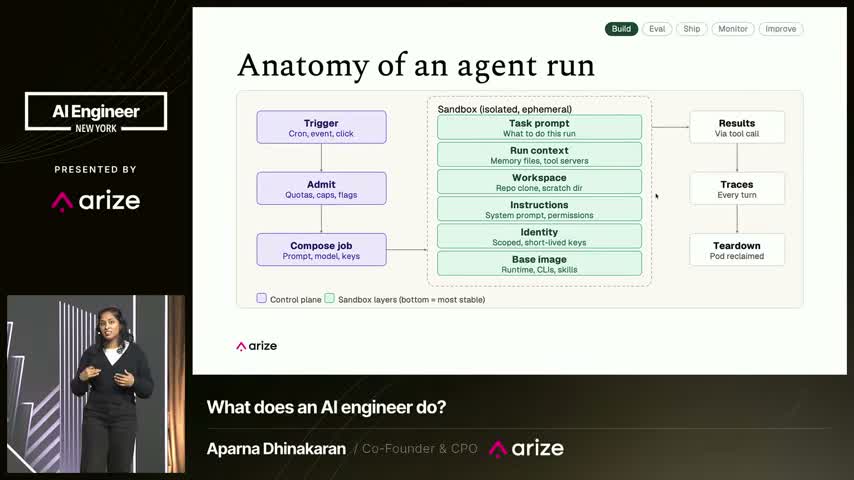
1:32:29And so the first thing that if you're building a team of,
1:32:32you know, a factory of really always-on agents
1:32:34is what triggers these agents to wake up or start.
1:32:38And there can be a variety of triggers.
1:32:41For signal, for us, it's configurable to run on an ongoing cadence.
1:32:46So every three hours, six hours, go pull the last X amount of traces, read them, identify problems.
1:32:54It can also be triggered by events.
1:32:57So Slack messages, if some user complains about something, it can be a metric-based trigger.
1:33:05But these are essentially triggers to kick up the agent actually starting.
1:33:10Once the agent actually starts, we have to spend some time figuring out, well, what does
1:33:14an agent run actually look like?
1:33:16For us, we actually pull in all of the context of the traces, any additional third-party
1:33:24data, so we allow collecting to APM logs, APM metrics, but all of the third-party telemetry
1:33:31data that we want to pull in, access to the repo, access to any keys that are needed to
1:33:44But all of this information is put inside of a sandbox, and this is actually what's started
1:33:51up every time the agent wakes up.
1:33:54And so the agent's triggered.
1:33:57We put everything that we need inside of that sandbox.
1:34:00The only way to get information in and out of the sandbox is by the single proxy.
1:34:05And everything that happens inside of that sandbox is actually already getting traced.
1:34:10And every output, so the issues that are generated and created are all getting saved to some kind of memory.
1:34:17And so this happens every single time the agent actually runs.
1:34:21Every time the agent finishes running, so it's sweeped through all of the traces,
1:34:26it either found something or it didn't.
1:34:29there's what actually stays and what actually gets thrown away what stays is
1:34:35that if it found any issues all of the output is actually saved off in some
1:34:39kind of memory so that the next time an agent gets spun up it doesn't have to
1:34:42start from ground zero it has a history of what are the issues that it actually
1:34:46found the agents are traced so all of the telemetry data of what the agent
1:34:54called you know if it actually put up a PR all of those things are actually
1:34:58traced, and any skills that it may have learned while actually doing a run can also get saved
1:35:05But the things that go away is the sandbox gets torn down, any credentials obviously
1:35:11get removed, the repo access is removed, and so all of the stuff that doesn't need to be
1:35:18saved kind of gets torn down after the run of Signal.
1:35:22And we've designed Signal in a way to actually keep this agent durable.
1:35:27So that means that either if the sandbox fails or if the harness fails, then it shouldn't have to start everything from scratch in the middle of the run.
1:35:38It should actually just be able to pick up from the step that it failed and all of the state so-called is kind of saved off in kind of a memory outside of the sandbox.
1:35:50And so we've designed this to actually be a very durable agent so that if it fails, it can spin it back up.
1:35:59You can launch a new sandbox, launch a new harness to kind of pick back up where it started.
1:36:03So all of this is essentially the underpinnings of how we built signal to run every single run.
1:36:10Agent gets triggered, agent gets started, loaded with all the context, the evidence.
1:36:14It sweeps through the telemetry data.
1:36:17It either finds something or it doesn't.
1:36:18All of that gets saved to memory.
1:36:20If something fails in the middle, the agent can get reset up.
1:36:24And we built Signal to also be agnostic of the model or the harness.
1:36:29So today, Signal supports not just Claude Code, which is what we started with,
1:36:33but it also supports Cursor and Codex.
1:36:36And the goal is to actually support all of the major, even the open source harnesses out there.
1:36:40and Signal actually also supports multiple models.
1:36:49So even if you're using Claude Code,
1:36:51you can pick any of the models inside the Anthropic family.
1:36:55And this is really important to us
1:36:58because one, it's an awesome way for us
1:37:00to evaluate the quality of the agent
1:37:05It helps us control costs so we can see
1:37:08as we use more powerful models, the better quality maybe the PRs are, but can we reduce
1:37:14the cost and actually still maintain the rigor and maintain the quality of issues that are
1:37:23actually detected by signal? So this is something we deeply thought about from first principles
1:37:28when we were designing signal. And this is actually a pretty good segue into what does
1:37:34an AI engineer need to do? Well, an AI engineer really needs to kind of learn how to write evals.
1:37:40And so we actually, every time Signal runs, Signal finds an issue, it puts up a PR. Well,
1:37:45there's evals that are run on top of the agent to test that PR. And an eval can be as simple as
1:37:53testing something as part of your development workflow. You have a data set. You can be a
1:37:58simple prompt with outputs that you're testing to make sure that there's no regressions.
1:38:05But these evals can also, they need to be kind of aligned with human judgment. And I'd argue that
1:38:12this is actually probably where an AI engineer should be spending a lot of their time as they're
1:38:18building the system to actually run the loop. They should be actually spending time looking at the
1:38:23traces with their agents, identifying what the common errors are. And there's a lot of skills.
1:38:30I think I was hearing Lance yesterday talk about the Claude skill to build evals. We have a skill
1:38:34with Arize Evaluator to actually help you build and write evals, as well as align those evals
1:38:41with the human judgment. But this is probably where the shift to defining what is good becomes
1:38:48really, really important for an AI engineer to actually do.
1:38:52And for a lot of teams I think we speak with and we work with,
1:38:56their question becomes, well, how do I trust the evaluator?
1:38:59And do I really trust that the eval is going to catch?
1:39:08How do I trust that it's as good as my judgment?
1:39:11And I'd say what we spend a lot of our own time doing for our own products
1:39:14is that we actually evaluate the evaluators.
1:39:18We spend a decent amount of time on actually building these data sets, golden truth data sets.
1:39:25We run evals, verify them against the human output, and then try to align to make sure that the judge actually agrees with the human
1:39:35and they're in agreement before we actually ship out a new evaluator.
1:39:40And these evals can then be used both in an offline testing as well as in an online testing manner.
1:39:48And this is probably what I would say as an AI engineer,
1:39:52is more and more of what the job is becoming.
1:39:57And so what I'm going to leave you guys with is,
1:40:00as an AI engineer, you've built this agent. You've built this agent to actually run, be always on. You run evals before you actually ship it into production. You can ship it. And then once it goes into production, the goal is to actually trace everything. And tracing everything now means not just tracing the agents, but also tracing the coding agents behind the agents that build
1:40:25built this. So you can trace Claude Code, you can trace Cursor, you can trace Codex, but
1:40:32all these coding agents can be traced so you can understand what happened in the factory
1:40:37of agents that you all are building. And then these agents, all the traces can then also
1:40:43be evaluated online. So there's an offline evaluation when you're actually testing what
1:40:51But as it goes into production, these become your online evals that you're running on top
1:40:58This, for us, ends up becoming the new data that then gets pulled back into the agents
1:41:05to read the telemetry data, the evals, and surface up problems inside of the traces.
1:41:12So the system really becomes how do you go from collect data, eval that data, run agents on top of it so that you can find problems and figure out where the gaps are to actually improve your systems.
1:41:27So if I go back to kind of the question that we started this whole thing with, it's what does an AI engineer do?
1:41:33I mean, the gap between, I think there's a pretty big gap between what's happening in the labs today and what's happening with a lot of businesses.
1:41:41And some of it could just be the data inside of businesses are a lot more messy than what is very constrained and testable inside of a lab.
1:41:50But AI engineers are kind of the role to close that gap.
1:41:55And I think it really starts with tracing everything, tracing the agents you're actually building, running evals, being able to learn how to test these products that we're really building.
1:42:05and then how do you build a system so that agents can actually improve
1:42:11from the telemetry that's actually being collected
1:42:14so that you're no longer just building individual features
1:42:17but you're actually building the system to improve your products.
1:42:22If you want to learn more, come check out.
1:42:25You can check out Signal, learn more.
1:42:27But thank you so much for listening to us.
No passages match. Try a shorter word or phrase.