
← All talks

AI Engineer NYC 2026 · Main stage · 14 min

Chasing capabilities while waiting for the frontier

Alexander ShevchenkoRamp

Ramp keeps adopting better frontier models. Alexander Shevchenko shows where specialist training, prepared context, and parallel agents can still save users time before the next model arrives.

Why do research if the next model will be better?

20:53 ↗

Ramp’s model usage is growing while the cost of doing the same work is falling. Alexander Shevchenko reports that the number of LLM use cases at the company grew 123% over the preceding year. Some major features were spending more on tokens overall, yet getting cheaper per unit of work as new models arrived.

That creates an awkward question for an applied-research team at an application company: why not wait? If the next model will be faster, cheaper, and more capable, how much engineering should go into overcoming today’s limitations?

Shevchenko goes back to 2023. Building an agent around GPT-4 meant constraining its behavior, keeping its context small, and worrying that a different word in a prompt might change the result. A model that took a wrong turn often kept going. Ramp shipped agents anyway because its finance customers had work to do before the next model release.

By 2026, a model could handle much more context and choose among tools with far less scaffolding. That made the basic agent easier to build. It also changed where additional work could pay off. Ramp Labs looks for expensive or slow steps inside an otherwise capable agent, then asks whether a narrower model, advance preparation, or more parallel attempts can improve the experience. The question begins at 21:32.

Let the planner ask a faster specialist

23:33 ↗

Ramp Sheets began as a general-purpose spreadsheet agent. Finance and accounting users spend much of their day in spreadsheets, so the team could reuse its harness and model capabilities elsewhere in Ramp. But a common request exposed a bottleneck: drop in several spreadsheets and ask for a discounted-cash-flow valuation or another financial scenario.

Before doing the financial work, the agent spent time planning and exploring the sheets. Claude Opus 4.6 could do that exploration, but its reasoning took time and consumed expensive tokens. The frontier model was being used both to decide what to do and to answer the many narrower questions needed to make that decision.

Ramp kept the frontier model as the orchestrator and trained a specialist for financial question answering. The planner could hand a retrieval question to that faster model, get the answer, and continue. Working with Prime Intellect, the team post-trained Qwen3.5-35B-A3B into the model labeled FastAsk on the slide.

The comparison places accuracy and time on separate axes, so the benefit is visible in one picture.
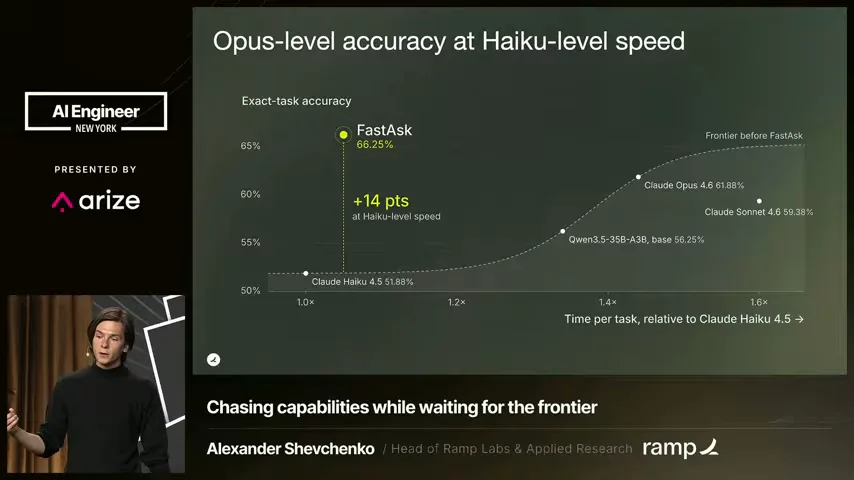
FastAsk exact-task accuracy versus time per task, compared with Claude and the base Qwen model.

At 25:45, Ramp reports 66.25% exact-task accuracy for FastAsk, compared with 61.88% for Opus 4.6, at close to Haiku-level time per task. These are results for the task comparison shown, not a general ranking of the models.

The useful unit of specialization is the subtask. A faster question-answering model can improve the whole spreadsheet agent without taking over the planning job. Shevchenko says this work had reached production.

Prepare the month before the accountant opens it

26:14 ↗

Some financial tasks are predictable before anyone asks the agent to perform them. When the month ends, an accountant will need to reconcile the books. The ledger, aging report, and open invoices are already identifiable. An agent can retrieve them on demand, but the user then waits while it builds an understanding of material the system could have prepared earlier.

Ramp is exploring KV cartridges to move that preparation offline. A transformer’s key-value cache holds representations of context that it can reuse while generating an answer. The Cartridges research from Hazy Research trains a smaller cache on a document collection in advance, using synthetic conversations about that collection. The resulting cache can be loaded for later requests. This is background for the technique; the published research’s benchmark results are separate from Ramp’s application.

Shevchenko describes building a cartridge overnight, before the accountant starts the next morning. The timing change matters more than a generic promise of a longer context window: the agent can begin reconciliation with the relevant information already represented in its cache.
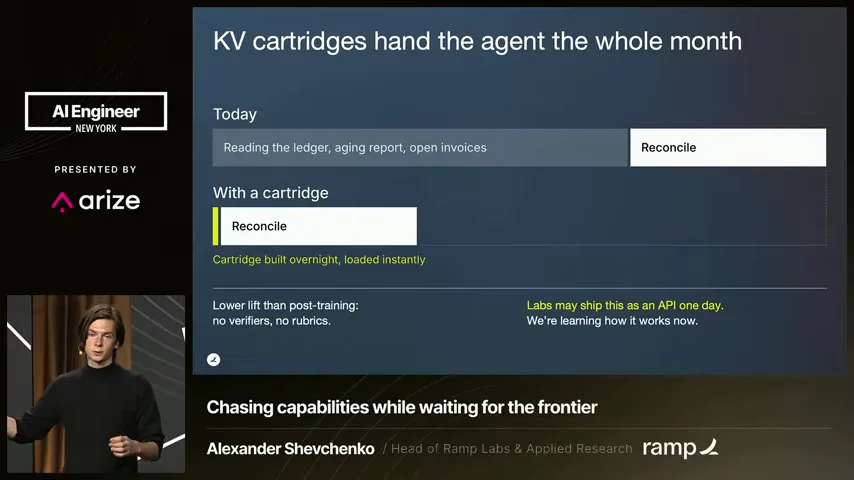
A timeline compares reading financial documents before reconciliation with loading an overnight cartridge before reconciliation.

The slide at 27:18 moves the ledger-reading work out of the user’s session. Its bars explain the sequence; they are not a measured latency scale.

Cartridges remain an area of exploration in this talk. Shevchenko also accepts that a frontier lab may eventually offer the capability through an API. That would make Ramp’s experience useful immediately: the team would already know which contexts to prepare and where the technique helps. Learning how to use a capability can retain value even when another company later supplies it.

Search in parallel, then challenge the findings

28:07 ↗

Security scanning offers a different opportunity. A single unsuccessful attempt costs tokens, while one successful attempt can uncover a real vulnerability. Ramp used its background coding agent, Inspect, to run roughly 10,000 scanning sessions against its backend.

The work does not end when those agents file tickets. Their outputs need a second round of work before a security team can act on them:

  1. Search: agents inspect different parts of the system for potential vulnerabilities.
  2. Deduplicate: agents merge reports that describe the same underlying issue.
  3. Challenge and reproduce: agents try to establish whether the reported behavior is reachable, consequential, and reproducible.

This is agentic map-reduce: distribute the investigation, then use further agents to turn the results into a smaller set of useful findings. Shevchenko reports seven high-severity issues, all patched. One involved Lua injection through an incoming email. The failure required following data through several components that appeared safe in isolation. Ramp’s published investigation gives the full pipeline and the email example.

The same setup lets the team compare models by the findings they recover for their cost. A cheaper model can be less successful per attempt and still be useful when the savings buy more attempts.
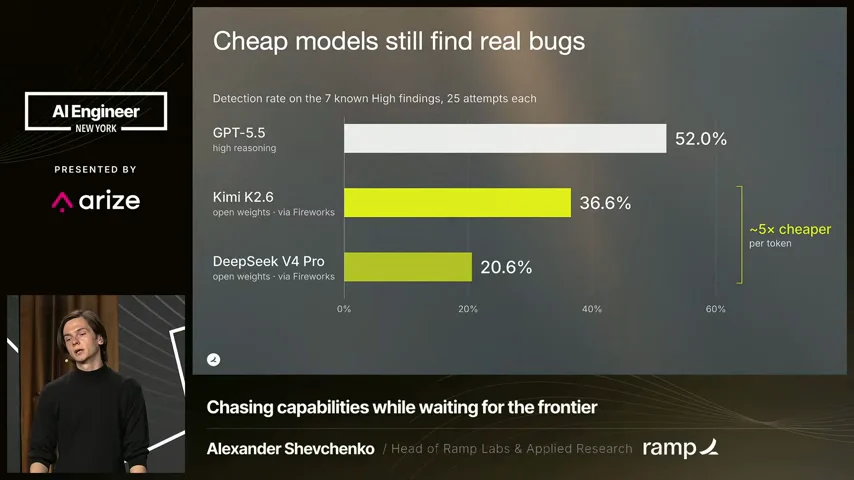
Detection rates for GPT-5.5, Kimi K2.6, and DeepSeek V4 Pro on seven known high-severity findings, with 25 attempts per finding.

At 30:00, the slide compares detection on seven known findings, with 25 attempts per model per finding: 52.0% for GPT-5.5, 36.6% for Kimi K2.6, and 20.6% for DeepSeek V4 Pro. The two open-weight models are labeled roughly five times cheaper per token.

Those rates do not show that the models are interchangeable. They show why model choice belongs inside the design of the search. The strongest model finds more per attempt; cheaper attempts can cover more ground within a fixed budget. Reproduction and severity review still have to separate a useful discovery from a persuasive ticket.

Turn the research into cheaper work

30:25 ↗

The three examples reduce different kinds of waiting and expense. The specialist shortens repeated question answering. Cartridges prepare context before the user arrives. The swarm spends parallel attempts where a single successful discovery can justify many failures.

Shevchenko connects that work to two products:

  • Token spend management attributes usage beyond an API key or employee. Semantic analysis can group what people are actually doing with models, then connect those categories to spending.
  • Ramp Router applies routing strategies to improve latency and token cost, including ways to move suitable work to cheaper service tiers.

The final research example returns to the risk of building something that the next model makes obsolete. PorTAL, short for Portable Task Adaptation for LoRA, explores learning a task representation that can be transferred to another base model. Rather than simply copying an adapter between incompatible models, the method keeps a shared learned representation and fits a small alignment for the new base. The aim is to avoid paying the full specialization cost again whenever the model changes.

Other projects apply the same research effort to practical operations: creating and revising Datadog monitors, and grouping user sessions into an open-ended taxonomy of model usage. That taxonomy feeds back into spend analysis.

Waiting for the frontier would have left Ramp’s 2023 customers without useful agents. Shevchenko’s current work makes the same decision at a smaller scale: find the step that costs the user time now, improve it, and learn enough that the next model release becomes an upgrade rather than a reason to start over. Watch the closing projects at 32:20.

Further reading

Ramp’s parallel security scan ↗The scanning, deduplication, and adversarial validation pipeline discussed in the talk.Cartridges: storing long contexts in tiny caches ↗Background on the trained KV-cache technique behind the month-end preparation example.PorTAL: Portable Task Adaptation for LoRA ↗Ramp’s research on preserving task adaptation when changing base models.

Full transcript

Timestamps follow the original livestream. Select a time to watch that moment. Transcripts are machine-generated with reviewed name and terminology corrections; occasional recognition errors may remain.

20:29

Hey, everyone.

20:30

I'm Alex from Ramp.

20:32

I'll be speaking about chasing capabilities

20:34

while waiting for the frontier to advance.

20:37

So a quick intro about myself.

20:39

I joined Ramp around three years ago

20:41

on the broader Applied AI team,

20:43

working on a bunch of different surfaces and products,

20:46

applying LLMs and ML to make a great product even better.

20:53

and to caveat my presentation on ramp labs ramp is an extremely bitter lesson build company

20:59

over the last year the number of use cases that use lms has increased 123 percent

21:04

while at the same time a lot of our top features are growing in token spend but on a unit economic

21:12

basis they're actually becoming cheaper because there are frontier models that are being released

21:18

all the time now, and these models are cheaper, faster, and better.

21:22

And so we're able to provide the same level of accuracy

21:26

at a much lower cost.

21:28

And so this is a really bitter lesson-pilled pattern.

21:32

And so given all this, a question that I sometimes get,

21:37

why not just wait?

21:38

Why have an applied research function inside of a company like RAMP,

21:43

an application layer company, right?

21:46

And to answer that, I would like to draw a parallel to 2023.

21:51

Back in 2023, you had access to kind of like GPT-4,

21:56

and creating an agent was a lot of work.

22:00

You would have to create very, very strict guardrails.

22:03

Models weren't RL'd to backtrack.

22:05

They didn't have thinking tokens.

22:07

And so if it went in the wrong direction,

22:09

it would just kind of charge ahead

22:11

and not realize that it made mistakes.

22:14

You had to sweat over all of the prompts to the point where some synonyms could change the behavior of your agent

22:23

because they weren't RL'd properly on generalizing to the user's intent.

22:28

You had to reduce and scope down the context as much as possible

22:32

because giving too much context to the agent would just confuse it.

22:38

And even back then, we decided, well, we need to ship these things.

22:42

We can't wait for GPT 4.5 or GPT 5 to come out.

22:46

We need to serve our financial professionals now.

22:49

And we should, things like RAM Tour Guide and many other agents,

22:53

even though it was not the easy thing to do.

22:56

And fast forward now to 2026, building an agent is a lot easier.

23:00

The models have gotten so much better that you can kind of give them MCPs

23:03

and access to kind of any context.

23:06

And they do a very, very good job of understanding

23:08

what they need to do given a task.

23:10

But I still believe that we can dig a layer down and create even better experiences for our users.

23:19

just it requires a bit more effort now.

23:22

So to present this, some of our work from Ramp Labs, three specific cases of how we've applied research into Ramp itself,

23:33

starting with creating a specialist model.

23:37

So in November of last year, we launched Ramp Sheets,

23:40

which was one of the really early spreadsheet agents.

23:45

This was before the two frontier labs had launched their versions of spreadsheet agents.

23:49

And we had a very good launch in November.

23:52

A bunch of users from great companies had signed up and started using it.

23:56

And we realized that, well, this is a very general purpose spreadsheet handling agent.

24:02

and a lot of the work that people do on RAMP,

24:05

both inside of the company,

24:08

but also all of our customers, accounting, and finance professionals,

24:11

are spending most of their days inside of spreadsheets.

24:14

So we can kind of take the harness and the brains behind RAMP sheets

24:19

and add it into a bunch of other surfaces within RAMP.

24:25

And as we were building this out,

24:27

we realized, well, we can probably apply some research from RAMP Labs

24:32

to make this even better.

24:35

And we sat down and we started looking,

24:37

where do models fall short on this?

24:39

And back then, this was like Opus 4.6.

24:42

And the place that had the most friction

24:45

was when you would drop in a lot of spreadsheets

24:48

into RAM sheets and you would ask it to build a DCF

24:51

or model some financial scenario.

24:54

It would spend a lot of time creating a plan at first

24:56

and then researching all of the sheets

24:58

that it had access to,

24:59

to try to get a good understanding

25:02

and the lay of the land.

25:04

And Opus 4.6 is a great model,

25:06

but it was pretty slow,

25:08

and the thinking tokens are also pretty expensive.

25:11

And so we took a step back

25:13

and decided to train a retrieval model,

25:16

or kind of like a financial question-answering model

25:18

that would, while still keeping these frontier models

25:21

as orchestrators,

25:23

would then be handed off to this much faster model

25:27

that would do financial question-answering

25:29

for that planning agent.

25:32

And so we partnered with the company Prime Intellect to post-train a Qwen 3.5, 35 billion model.

25:42

And we actually got above Opus 4.6, which was the frontier back then, exact task accuracy,

25:49

while also being able to serve it at Haiku level latencies.

25:53

So a much faster but just a smart model that could then be used in tandem with the really smart frontier orchestrator.

26:04

And so this was a very successful example of post-training that we had actually sent to prod as part of our Ramp Labs effort.

26:14

The second big thing that we are actually exploring up to this day is KVCache

26:21

tricks and particularly cartridges are a really interesting family of techniques where you're able

26:29

to compress a lot of context up to 20 to 30 times more context into the kv cache offline and serve it

26:37

for your agent and so if you compare it to the ramp sheets example for example

26:43

there's a lot of tasks that you know are going to happen at some point right like month end close

26:48

a month finishes and on the first of the next month a financial professional will go and try

26:53

to reconcile and close their books you know kind of the ledger the aging report and the documents

26:59

that they will need to be retrieving and so you could prepare them as context but the agent will

27:03

still need to agentically retrieve and create a good picture and understanding of them with

27:10

cartridges we're able to compress all of that work and build one overnight before the the

27:16

financial professional starts their work on the first of the month and once they

27:21

open up the the agent it knows exactly what it needs to do because it has all

27:26

of the context already built in cartridges are also a much lower lift

27:30

in post training because the way that they do self play is kind of a lot more

27:34

generalizable the caveat with stuff like this is that compared to post training

27:39

this is something that the labs might ship at some point in their API's in

27:44

their foray into continuous learning.

27:49

Even if they were to do it in the API,

27:51

we would actually be happy because we

27:52

are developing a lot of this tribal knowledge

27:54

inside of the company and just learning how best

27:57

to apply these techniques.

27:59

So even if it does ship as an API,

28:01

we can just hit the ground running on day one,

28:03

knowing how to use them.

28:07

And finally, the third example of applied research

28:12

that we are sending to prod is our work on agentic map reduce

28:16

and kind of agentic swarms.

28:18

So more concretely, we published an article on the Ramp Labs blog

28:23

on how we used 10,000 parallel agents to pentest all of Ramp.

28:30

So at Ramp, we have a cloud agent called Ramp Inspect,

28:35

which helps out with setting up all of the infrastructure and plumbing

28:38

for something as ambitious as this.

28:40

and we were able to spin up 10,000 parallel agents

28:44

and then kind of map this work out,

28:47

try to find any vulnerabilities,

28:49

and then also agentically reduce on the tickets that they would create.

28:53

So deduplicate them with LLMs

28:55

and then try to reproduce them adversarially with LLMs

28:58

to try to make sure that the vulnerabilities are real and important.

29:02

At the end of all of this,

29:04

we have actually found seven highest severity vulnerabilities

29:07

that we all patched.

29:09

Interestingly, one of the vulnerabilities that we described in that article is a Lua

29:14

script injection that you could send over via email.

29:18

And no single component of that stack was unsafe, and the kind of swarm had to patch

29:25

together multiple components and understanding of multiple components end-to-end in order

29:30

to be able to figure this out.

29:32

And the other nice thing with this is that this is all running automatically.

29:36

You don't need to spend anyone's time.

29:38

is just use started and the only thing that failed passes that get filtered out is the cost of the

29:44

tokens. The other thing that's interesting outside of just building out all of the infrastructure to

29:50

support these swarms is that we do research into how to best use models as part of these swarms.

29:58

One of the interesting

30:00

insights from that same article that we published is that you can actually use open weight models that are up to five times cheaper compared to the frontier reasoning.

30:09

Because you're setting it up as a swarm, the detection rate is not five times lower.

30:14

So, you can kind of spend more on these cheaper tokens and have almost as good of a detection rate.

30:25

If you follow through all of these examples, you kind of notice a pattern of a lot of them is attempts at saving on time and saving on money.

30:35

So reducing latency, which is time, and then reducing on token cost, which is money.

30:40

That's actually RAMP's slogan, saving our customers time and money.

30:44

And so I'd like to point to two products that we actually offer from RAMP that have been influenced by RAMP Labs' research.

30:53

The first one is token spend management that connects to a bunch of your API keys

30:58

and is able to give you a really good picture of how LMs are being used inside of your company.

31:03

Not only token spend on an API key basis or a user basis, but digging deeper.

31:09

Accounting categories and even things like tax credits that you can get by analyzing the spend.

31:19

It also goes deeper, and we create a taxonomy that contextually analyzes and semantically analyzes the LLM usage,

31:27

so you can actually understand how LLMs are being used outside of just attributing it to a team or a person inside of your company.

31:35

And then the second one is Ramp Router, which also leans into improving the latency of your agent,

31:41

where we have a bunch of routing strategies that we work with Ramp Labs to develop,

31:46

things like NVIDIA Switchyard, things like smart flex offloading of work to both improve latency

31:53

and cost per tokens that you spend. And there's a bunch of different strategies already available

31:59

for routing and even more coming out later. So if you're interested in any of these two products,

32:06

you can take a photo of the URLs or scan the QR codes there. I'll give you a second.

32:19

Awesome.

32:20

And then I'd also invite you to check out our RAMP Labs blog where we publish a bunch

32:27

of really interesting articles that I haven't had the chance to cover as part of this presentation.

32:32

Notably one of the really interesting ones is PorTAL where we figured out a way of transferring

32:38

learnings from one post train to another.

32:41

So you could do something like a LoRA post-train on one model,

32:46

so like the Qwen 3.5 that I was describing,

32:48

but then transfer it to newer versions of QAN

32:51

or even across different families.

32:53

So you're post-training this latent

32:55

that then can be projected onto different models.

32:59

And that really amortizes the cost

33:01

that you have to spend on post-training.

33:03

More blog posts on agentic map-reduce,

33:06

so not only the pen testing stuff that we did,

33:08

but also things like analyzing and creating taxonomies of LLM usage,

33:13

which is stuff that has gone into the token spend product.

33:17

Things like self-improving monitoring,

33:19

where we use LLMs to automatically create monitors with Datadog

33:25

on a lot of our product surfaces,

33:27

and then as alerts come in,

33:29

improve those monitors automatically without a person in the loop

33:33

to try to basically create super, super robust and resilient software.

33:38

And finally, semantic tagging, which is this interesting foray

33:42

into creating this egentic map reduce over a bunch of user sessions

33:47

where we can annotate and create taxonomies that are open-ended,

33:51

so not knowing ahead of time what are the clusters of LLM usage

33:57

and trying to create a taxonomy that can then be reconciled

34:00

against the spend inside of the companies.

34:03

So if you're interested in this type of research,

34:06

x.com slash ramp labs where you can go and check out more of our research and

34:14

there's my Twitter if you have any other questions or want to talk about some

34:19

use case as part of your applied research and that's it thank you