
← All talks

AI Engineer NYC 2026 · Online track · 15 min

The Agent Works. Does Anyone Trust It?

Michele Grant ↗Leading at Scale

Michele Grant follows an acquisition-reporting agent from a successful pilot to the evidence, ownership, and review practices needed for greater autonomy.

A correct report still needs a reason to run

4:28:27 ↗

Going live proves that software exists. It does not establish that people will use it, or that its output will produce the value promised in a business case. Michele Grant, creator of Leading at Scale, approaches agent deployment through her experience in enterprise transformation and acquisition integration. Trust has to be built into the operating process before launch.

She asks three questions of an agent: what value does it create, who is accountable for it, and what evidence justifies giving it more autonomy? A pilot can establish that the software functions. Production adds decisions about permitted actions, ownership, recorded evidence, and escalation. Engineers can implement those decisions, but leadership has to make them.

Grant carries an illustrative acquisition through the talk: a $15 billion deal targeting $400 million in net synergies, with an integration management office coordinating 40 workstreams. Analysts collect updates, reconcile them against the general ledger, compare actuals with the plan, and assemble the weekly steering-committee report. An agent automates the first draft. After a four-week pilot, its reports match the analysts’ work line for line. That is the beginning of the deployment decision.

Measure the change in decisions, not just report speed

4:33:01 ↗

The steering committee needs a written value case before production use. Grant separates three measurements that can otherwise disappear inside a vague claim of time saved:

  • Report cycle time: establish how long compilation takes today and set a target. In her example, the report moves from five business days to two.
  • Redeployed analyst capacity: four analysts spending half their week on the report represents 80 hours. Releasing those hours creates value only if the integration lead assigns them to work that needs attention. Compute, licensing, and human-review costs still count against the benefit.
  • Detection time: measure the delay between the first sign of a material problem and the committee seeing it. A faster report does not necessarily reveal a slipping initiative sooner.

Each measure needs a baseline. Without one, a convincing demonstration can become its own business case: the agent looks faster, but nobody can say what improved or whether the improvement mattered. The acquisition and capacity figures are teaching examples, not results from a disclosed deployment.

Keep the decision with a named owner

4:34:54 ↗

Grant applies three lines of accountability. Management owns the controls and output; the integration lead remains responsible for the report. Risk and compliance challenge how the agent operates, with scrutiny proportional to its authority. Internal audit provides independent assurance based on material risk. An internal draft reviewed by an analyst creates a different exposure from figures published directly to the board.

Someone also has to supervise the agent every day. That person needs to understand its limits, interpret its output, override or reverse it, and stop it safely. Giving a person a review task without those capabilities does not establish meaningful oversight.

Grant records the division of work in a one-page Human Works Standard. At each decision, it names the authorized human, required evidence, and escalation path. The analyst decides whether a variance is an accounting-timing difference or a real cash shortfall. The workstream lead decides how to remedy it. The integration lead decides whether to mark the initiative at risk. The agent prepares the analysis supporting those decisions.

The diagram follows a constructed mismatch through that division of work. The reported amount and ledger amount remain distinct until a person resolves the discrepancy.
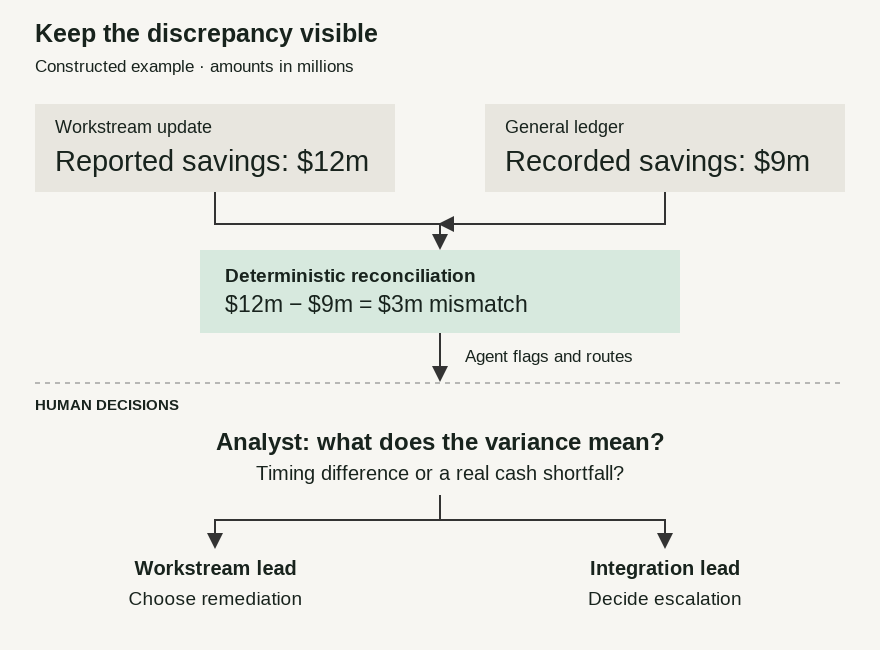
A reported12million in savings is compared with9million in the ledger; deterministic code flags a3million mismatch, and the analyst decides its meaning before management acts.

Illustrative amounts; the decision sequence follows Grant’s explanation at 4:36:44 and 4:38:53.

The reason to delay is an unowned decision. If nobody can declare an initiative off track, a more accurate flag still goes nowhere.

Build evidence that survives a model change

4:38:17 ↗

Greater autonomy rests on evidence from the system’s operation. Grant wants an auditable decision log containing the data ingested, tools executed, prompt and model versions, generated output, and human sign-off. Core reconciliation and financial arithmetic run in deterministic, finance-approved code. The model’s narrative helps someone understand the result; it does not replace the underlying records and calculations.

If reported savings disagree with the general ledger, the agent flags and routes the discrepancy. It does not quietly change the number to make the report agree.

A maintained inventory records the accountable executive, data lineage, system dependencies, validation results, escalation path, and shutdown procedure. It also defines regression triggers. A changed prompt, base model, or source API can change the agent’s behavior even when its product name stays the same. Grant calls for revalidation before those changes return to production.

Autonomy can advance—and move backward

4:40:16 ↗

An autonomy scorecard makes the next deployment decision explicit:

  1. Shadow mode: analysts continue producing the report while the agent runs beside them; the team compares the outputs.
  2. Supervised draft: the agent prepares the report and an analyst reviews every line item.
  3. Exceptions plus sampling: the analyst reviews flagged initiatives and a random sample of apparently clean ones.
  4. Exception-focused review: the analyst concentrates on high-risk anomalies, supported by periodic independent sampling.

The final stage changes where failures hide. When people see only what the agent flags, a missed material issue can stay invisible. Independent sampling checks the apparently clean work and measures the severity of missed issues. A falling override rate is ambiguous: the agent may have improved, or the humans may have stopped looking as closely.

The scorecard puts those controls beside cycle time, redeployed hours, and detection time. The committee can promote the agent, hold its current authority, or return it to more supervision. Autonomy is a decision supported by continuing evidence.

Grant closes by returning to the acquisition. An agent does not create $400 million in synergies by writing the report. Procurement, supply-chain, and operating teams still have to do the integration work. The agent’s contribution is earlier, verified information that gives those people time to act.

Further reading

Michele Grant — Leading at Scale ↗The speaker’s work on enterprise transformation and acquisition integration.

Full transcript

Timestamps follow the original livestream. Select a time to watch that moment. Transcripts are machine-generated with reviewed name and terminology corrections; occasional recognition errors may remain.

4:28:27

GoLive proves that a system exists, but it doesn't prove the people behind the work will actually use it.

4:28:35

or that it will ever deliver a single dollar from the deal model.

4:28:39

I am Michele Grant, creator of Leading at Scale,

4:28:43

and the question every enterprise is confronting right now is the agent works.

4:28:49

Does anyone trust it?

4:28:51

I have spent over 20 years in enterprise transformation

4:28:55

and more than a decade leading M&A integrations across media, tech, and consumer goods.

4:29:03

On those deals, trust was not something we crossed our fingers and hoped for after launch.

4:29:11

We engineered it before day one through early change management and risk management.

4:29:19

So when the platform went live, the teams on the ground actually relied on it.

4:29:27

AI agents demand the exact same muscle.

4:29:31

An agent earns trust when it delivers the value the business budgeted for while staying

4:29:39

safely within the company's approved risk appetite, policies, and regulatory guardrails.

4:29:47

In my experience, leadership gets there by answering three straightforward questions.

4:29:54

What value does it create?

4:29:57

Who is on the hook for it?

4:30:00

And what evidence gives it permission to run with greater autonomy?

4:30:05

The moment an agent steps out of a sandbox and into a core business workflow, the entire test changes.

4:30:14

A pilot tests whether the software functions, but daily operations is where we test whether it creates value within the controls set by leadership.

4:30:27

Established AI risk frameworks give you strong principles.

4:30:31

What they do not give you is how to apply these principles to each agent.

4:30:37

For every agent, leadership has to decide four things.

4:30:41

What is it permitted to do?

4:30:44

Who owns it?

4:30:45

What evidence it records?

4:30:48

And what triggers an escalation?

4:30:52

That work is not an engineering task.

4:30:55

We find it is an executive operating mandate.

4:30:59

And today, I'll show you how to meet it.

4:31:03

Let us ground this in a real-world scenario.

4:31:07

own. Picture a $15 billion acquisition targeting 400 million in net synergies. The deal has already

4:31:17

closed and the integration efforts are now underway. The integration management office,

4:31:23

which we'll also refer to as the IMO today, is driving the synergy roadmap across 40 work streams,

4:31:32

covering everything from rationalizing vendor contracts to consolidating ERP systems.

4:31:39

And every single initiative has a business owner accountable for its bottom line savings.

4:31:47

Every week, analysts in the IMO are going to reconcile the numbers against the general ledger

4:31:56

as they track down status from all 40 leads.

4:32:01

They're also comparing actuals against the plan,

4:32:05

then finally assembling the executive deck for the steering committee,

4:32:10

which is going to include the CFO, the chief risk officer,

4:32:15

business unit heads, and the integration lead.

4:32:19

The engineering team builds an agent to automate that first draft.

4:32:26

The agent then ingests the weekly updates, reconciles the ledger, runs variance math against the plan, and flags the initiatives that are falling behind.

4:32:38

Everything looks good, and they decide to run a four-week pilot.

4:32:42

The agent's drafts match the analyst's reports, line for line.

4:32:48

So we can say that the tech works.

4:32:51

Now, the question is, what value does that steering committee need before they can trust it to run the business?

4:33:01

First, the steering committee needs a written value case, agreed upon before the agent ever touches production data.

4:33:11

In our example, that comes down to three specific metrics.

4:33:17

First, let's look at cycle time.

4:33:20

If that weekly report eats five business days to compile right now, you're going to want to set a hard target such as two days.

4:33:30

Your second metric will be analyst capacity.

4:33:34

If four analysts spend half of their week building the stack, that is 80 hours a week the agent gives back.

4:33:44

That time counts as value only when the integration lead assigns it to the work streams that are behind on their synergy targets and need help getting back on track.

4:33:57

Then you only count that value after netting out the compute, licensing, and human review costs of running the agent.

4:34:09

Your third metric is the most important one, detection time.

4:34:14

That is how long it takes from the first sign of a slip in the data to the moment the steering committee sees it.

4:34:21

Cutting the report from five days to two days does not guarantee that the committee sees that slip any sooner.

4:34:30

The agent has to catch it, and the value case measures that directly.

4:34:37

Every single metric requires a pre-deployment baseline.

4:34:41

If the IMO cannot state the baseline today, do not deploy.

4:34:47

If you can't measure where you started, you can never prove the agent moved the needle.

4:34:54

Next, the steering committee needs to know who owns the risk the agent creates.

4:35:01

We are going to apply the three-line model to the agent.

4:35:06

In the first line, management owns the controls.

4:35:10

The integration lead is the accountable executive.

4:35:14

She owns the agent's output exactly the way she owned the manual deck.

4:35:20

In the second line, risk and compliance oversee the agent and challenge how to run it.

4:35:28

How deep they go depends on the agent's exposure.

4:35:32

An internal draft scrubbed by a senior analyst warrants a very different review standard than an autonomous agent publishing figures straight to the board.

4:35:44

In the third line, internal audit provides assurance deciding based on material risk when and how the agent enters the annual audit plan.

4:35:56

The agent also needs one employee assigned to oversee it every day.

4:36:04

In our example, that is the senior analyst.

4:36:08

reviews the draft before it reaches the community.

4:36:12

Her role requires four specific capabilities.

4:36:15

She has to first understand the operational boundaries.

4:36:20

She has to interpret its output with context.

4:36:23

She must have the authority to override or reverse it, and she needs a clear kill switch to shut it down safely the second it behaves unexpectedly.

4:36:39

Accountability also means defining where the agent's authority stops.

4:36:44

I document this in a one-page policy called the Human Works Standard.

4:36:50

For every fork in the process, it maps the decision the human role authorized to make it, the required evidence, and the escalation path.

4:37:03

These decisions exist at every tier.

4:37:07

senior analyst decides whether a variance is an accounting timing difference or a real cash shortfall.

4:37:14

The work stream lead decides how to remediate that shortfall.

4:37:19

And the integration lead is going to decide whether to formally flag an initiative as at risk to the steering committee.

4:37:28

The agent prepares the analysis behind every one of those decisions, and it stops there.

4:37:37

The person who makes the decision owns the consequence.

4:37:42

So keeping these decisions with your team does not slow the agent down.

4:37:47

It can go into use while each role keeps its authority.

4:37:53

one reason to delay deployments is a decision with no assigned owner.

4:38:00

This means if leadership has not agreed who declares an initiative off track,

4:38:07

the agent's flags lead to no action. The third question is where the engineers in this room

4:38:17

come in. The evidence for greater autonomy comes from how the agent is built. I look for three

4:38:26

artifacts. The first is an auditable decision log. For every work stream the agent evaluates,

4:38:34

it records the raw data ingested, the tool calls executed, the prompt and the model versions,

4:38:43

output generated along with the human sign-off. Two engineering choices make that log airtight.

4:38:53

First, your core math and reconciliation rules must run in deterministic finance-approved code,

4:39:02

not generated as conversational prose from an LLM.

4:39:08

Second, treat the model's written summary as a helpful explanation, not proof.

4:39:14

Your real proof lives in the telemetry.

4:39:18

What records were pulled?

4:39:20

What deterministic tools ran?

4:39:23

And who signed the review?

4:39:27

If reported savings do not match the general ledger,

4:39:31

Agent does not touch the number.

4:39:35

flats discrepancy and roots it up.

4:39:39

second artifact is the model inventory record.

4:39:44

captures the accountable executive.

4:39:48

lineage.

4:39:50

Dependencies across source systems.

4:39:53

Validation results.

4:39:55

Escalation path.

4:39:57

And the kill switch runbook.

4:40:00

Most importantly, it documents your regression triggers, which are any updates to our prompt, base model, or source API that require full revalidation before running in production again.

4:40:16

third artifact, this is going to be the Autonomy Scorecard.

4:40:21

The steering committee uses it to grant autonomy in four stages.

4:40:27

Stage one is shadow mode.

4:40:29

The analysts build the report as they do today.

4:40:34

agent runs right alongside them and the team compares the two.

4:40:38

Stage two is the supervised draft.

4:40:42

The agent compiles the first draft and the senior analyst reviews every single line item.

4:40:50

Stage 3 is the exception and sample, where the analyst reviews land initiatives plus a random sample of the claimants.

4:41:02

Then we have stage 4, where it's exceptions only.

4:41:07

The analyst reviews only high-risk anomalies, supported by periodic independent sampling.

4:41:14

Pay close attention to stage 4, however, because once humans only look at exceptions, your biggest vulnerability is what the agent failed to flag.

4:41:27

So I advise tracking missed material issues through independent sampling, monitoring error severity, and watching your override rate carefully.

4:41:38

A falling override rate does not automatically mean the agent is getting smarter.

4:41:44

It can also mean the depth of review has split.

4:41:48

So independent sampling tells you which one of these you are seeing.

4:41:53

The scorecard puts those control metrics side by side with your value metrics,

4:42:00

cycle time, analyst hours deployed, and your detection time.

4:42:05

And with that single page view, the steering committee can make clean, efficient data-backed decisions

4:42:12

to either promote the agent, hold it where it is, step it back, or down to supervised review stage.

4:42:23

So let's come back to the three questions.

4:42:28

Ask them of every agent you build, fund or govern.

4:42:33

What value does it create?

4:42:36

Who is accountable for it?

4:42:38

and what evidence permits it to operate with autonomy.

4:42:44

In our M&A example today, the agent does not magically create a 400 million in synergies.

4:42:51

Procurement, supply chain, and operating leaders capture that value through the gritty work of integration.

4:42:59

what the agent delivers is clear.

4:43:02

Verified evidence weeks ahead of schedule,

4:43:05

giving leadership the runway to intervene while the deal's synergies can still be captured.

4:43:13

Building an agent that works is just the first step.

4:43:17

Answering those three questions is what earns it the trust to run at scale.

4:43:24

Thank you.